

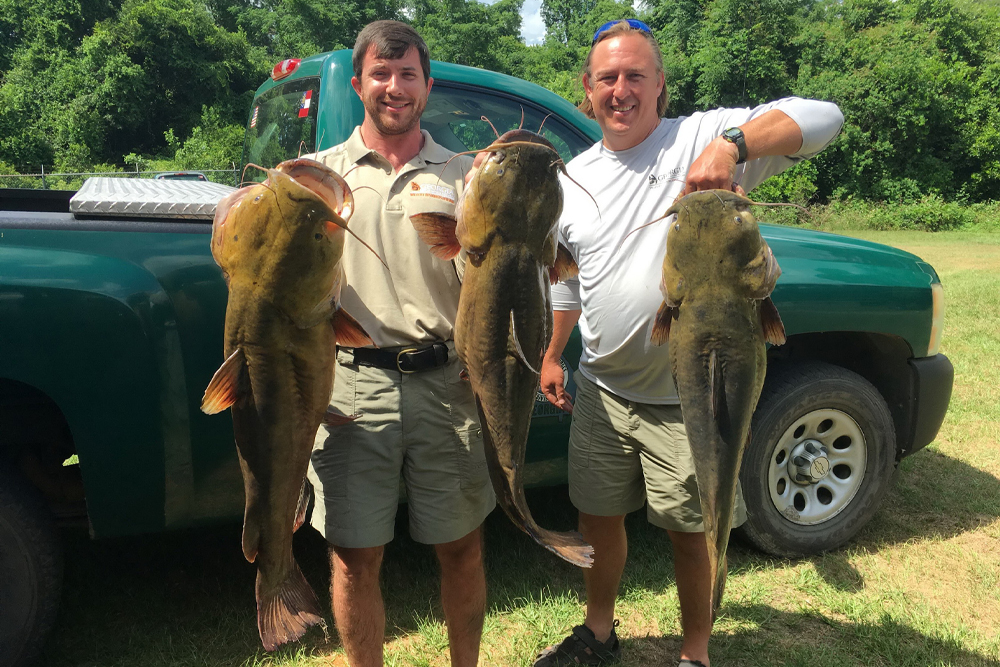
Georgia DNR fisheries technicians Jason Mitchell (right) and Scout Carter with
three flathead catfish taken in one of the state’s rivers where the agency is attempting
to suppress the quickly expanding population.
Are Flathead Catfish Invasive?
By Richard Hines
Photos courtesy of Georgia DNR
If someone mentions invasive species, kudzu might come to mind, or pythons in Florida. Unfortunately, it’s a long list, but who would have ever imagined that one of our favorite catfish, the flathead, could be included on this list?
Originally restricted to the central United States, flatheads were native to the Mississippi, Rio Grande, Missouri and Ohio river systems, but it seems of no fault of their own, they have overstepped their boundaries, and there are several reasons how this occurred. One instance involved the fish moving from the Mississippi River system into Lake Michigan sometime around 1910-1920. In 1965, 50 flatheads being held in a research pond escaped into Chesapeake Bay during a flood. However, other states purposely introduced this apex predator into new waters.
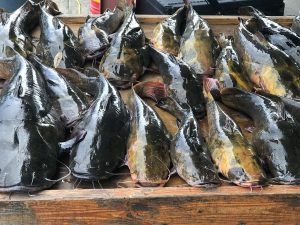
No matter the reason, flatheads are now setting up housekeeping in 18 states outside their original range, and this expansion is creating problems for native fish populations from Florida to Pennsylvania and even as far west as California.
The problem of releasing a fish capable of exceeding 50 pounds and living up to 30-plus years can be devastating to well-balanced river systems. Many of these streams are smaller river systems where the largest fish may reach only 20 pounds. But with the addition of these new predators, food sources for all fish are strained, creating a cascading decline in all levels of the river’s resources.
The Georgia Story
The Georgia Department of Natural Resources (DNR) has recognized this problem and has taken steps to begin reducing flathead numbers. A flathead catfish in Georgia is, according to their staff, the perfect conundrum. Flatheads are native to northwest Georgia drainages; however, this species is not native to the drainages flowing into the Atlantic Ocean. As a result, the same species is a treasured native fish in west Georgia and a despised invasive along Atlantic slope streams.
Georgia released flatheads in the Ocmulgee and Altamaha rivers in the 1970s. Over time, flatheads worked their way into the Ogeechee River. The Satilla River was also stocked in the mid 1990s, and it seems many of these stockings were coupled with numerous unauthorized introductions. The flathead population exploded in many of the state’s Atlantic slope streams, and by the 1980s, flatheads had become so abundant that the Georgia DNR decided to begin removing them in these eastern Atlantic slope streams.
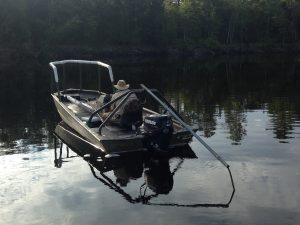
As flatheads become a problem, Senior Fisheries Biologist Jim Page said, “The idea was not to eradicate but to suppress the population as much as possible, mainly to reduce the impact flatheads were having on native sunfish populations.”
Among anglers, the jury is still out. Some like flatheads, and some don’t. Page told me,
“Flatheads are like liver and onions. You either love ‘em or hate ‘em.”
This is the case with flathead catfish in Georgia, especially along the Satilla River where sunfish, specifically redbreast sunfish, are an extremely important resource. Redbreasts are not only important forage fish supporting all fish in these river systems, but they are considered economically important for the large numbers of anglers who visit the area each year. Page said, “The redbreast fishery has been a treasure, not only for locals, but also for the many nonresidents who travel to Georgia to catch these trophy-size sunfish.”
When I asked the status of the flathead reduction program, Page said, “From 2007 to a couple of years ago, we were having great success, normally removing around 5,000 flatheads per year. But over the last three or four years, our catch rate has dropped.”
Several things are occurring that have affected this. Catch rates increase during low water when flatheads are concentrated. But over the past few years, the state has had heavy rainfall beneficial to flatheads, allowing their numbers to rebound.
Anyone who fishes for flatheads knows they can quickly take advantage of flooded conditions. Page and his fellow researchers have also noticed that as flathead numbers bump up, redbreast sunfish numbers go down. Page noted, “This usually occurs during floods when flatheads take advantage of the nearly limitless food sources as they can forage through the flooded bottomlands along the Satilla and other rivers.”
It’s Not Just Georgia
Other states have similar problems. Flatheads arrived in Idaho when they were accidentally stocked instead of blue catfish. Florida’s Apalachicola River received flatheads when they unexpectedly moved out of the Flint River following a stocking in Georgia.
The first known reports of flatheads in the western U.S. occurred when one was caught near Yuma, Arizona in 1966. Over time, flatheads moved into additional streams in Arizona, Colorado and New Mexico. Within 15 years of being introduced into North Carolina’s Cape Fear River, flatheads are now the dominant predator.
In healthy aquatic systems, all species are basically stair stepped, or, simply stated, one group is feeding on the next lower group and so on. While there is overlap, each group remains slightly separated, keeping things in balance.
For instance, in Pennsylvania’s Susquehanna River, smallmouth bass and channel catfish were always the primary predators until flatheads were established. Flatheads have now become the apex predator along 200 miles of river, feeding on everything from invertebrates to the original apex predators (smallmouth bass and channel catfish).
Don’t Move Flatheads!
There is not a catfish angler out there who dislikes flatheads, me included. But we need to keep them in their normal range. Please do not be tempted to move “just a few to your river.” All this can do over time is create major problems for any well-balanced stream. If a 60-pound predator is added to a stream that previously only had 20-pound predators, something must give. Flatheads need to stay where flatheads live—in their home range!
(Richard Hines is a retired wildlife biologist, book author and award winning freelance outdoor writer and photographer. Since 1985, Hines has published hundreds of articles on hunting, fishing, conservation, and natural history.)
