

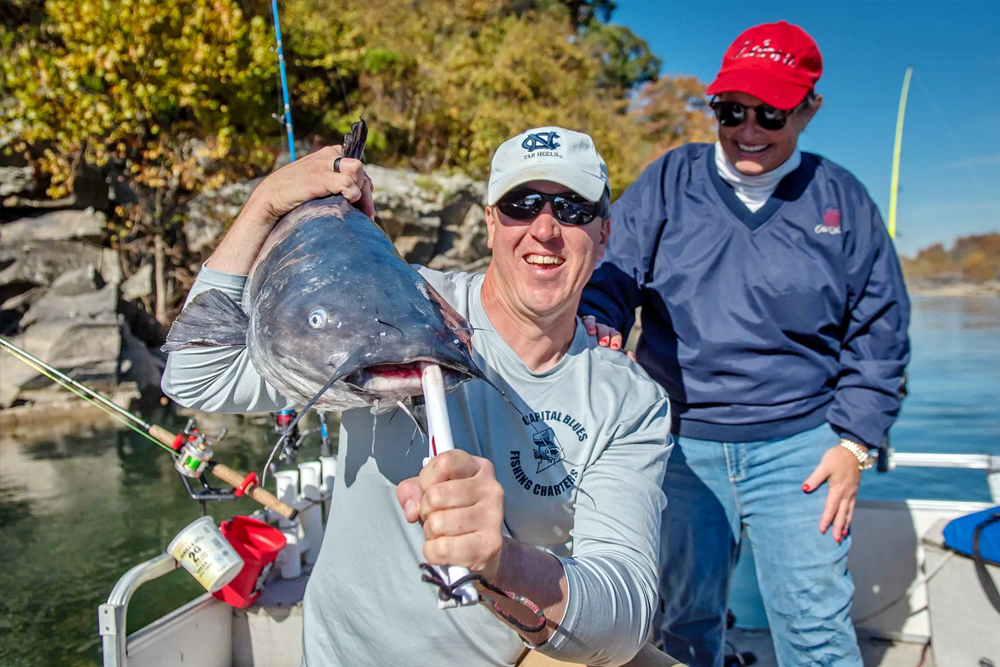
Guide Owen Koch and a customer celebrate catching
a big blue catfish in the Potomac River.
(Photo courtesy of Capital Blues Fishing Charters)
Chesapeake Blues
by Brent Frazee
Too much of a good thing? That describes the population boom of blue cats in the Bay’s tidal rivers.
Looking for a place where rivers are full of blue catfish, there are no creel limits, and the fisheries departments almost beg you to keep what you catch?
If that sounds too good to be true, it isn’t.
States along Chesapeake Bay on the East Coast have booming populations of blue catfish—too many, according to fisheries biologists. What started In Virginia as an innocent stocking experiment to create a new recreational fishery has turned into a beast.
Against all expectations, blue cats have expanded their range into virtually all tidal rivers in the Chesapeake, to the point where fisheries managers believe they are impacting native species such as striped bass, blue crabs and sturgeon.
So, blue catfish, the same fish that are highly sought in Midwest and Southern states, are no longer welcome in states that touch Chesapeake Bay. In Virginia, Maryland, Washington, D.C. and Delaware, they are considered an invasive species. They also are considered invasive in parts of Pennsylvania, North and South Carolina, and New Jersey.
That amounts to liberal limits, coolers full of eating-size fish and a shot at catching a trophy-size fish. Yes, anglers are benefitting as never before by management efforts to control catfish populations.
An Unexpected Problem
When the Virginia Department of Wildlife Resources (DWR) stocked the James and Rappahannock rivers with blue catfish in 1974, no one could envision the havoc they would one day create. Fisheries biologists thought the catfish would stay in the rivers in which they were stocked, and they would create a new trophy fishery. To their dismay, the new species proved much more adaptable to brackish waters and spread into most of the Chesapeake’s tributaries.
The blue catfish not only survived, they thrived. The voracious predators multiplied to the point where they not only competed with native species for food but habitat as well.
In diet studies, blue catfish were found to have consumed 30 to 40 different types of forage.
“They’re generalists, and they’re opportunistic,” said Branson Williams, invasive fishes program manager for the Maryland Department of Natural Resources (DNR). “Whatever swims in front of their face, they’re going to eat.
“What is really troubling is that we believe they take a lot of blue crabs before they (the crabs) reach market size.”
But it’s hard to place the sole blame on the blue catfish, Williams said. In the tidal rivers, factors such as climate, salinity, heavy rain and habitat also could play a part. And therein lies the problem.
Because the rivers all have unique characteristics, it’s hard to generalize as to how to manage the invasive blue catfish. In Virginia, the first state to deal with the influx of the large predators, the boom period is fading and numbers of big fish are down significantly from peak populations, according to Margi Whitmore, tidal rivers project lead for the Virginia DWR.
“Right now, we’re seeing a lot more small fish—smaller than 2 pounds or 12 inches,” she said. “That creates problems. Commercial processors don’t want fish that size; it isn’t worth their time. Recreational fishermen don’t want them either; they want something bigger than that. So, what you end up with is a dominant size-class fish that no one wants.”
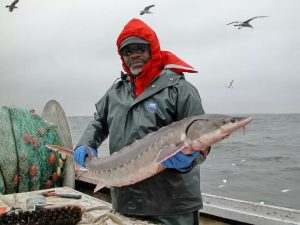
Further complicating the situation is that the blue catfish are competing with native fish for habitat. Consider the Atlantic sturgeon, a species that lives in the ocean but spawns in freshwater rivers.
“The biggest issue between the Atlantic sturgeon and blue catfish is habitat displacement,” Whitmore said. “When the sturgeon move into the rivers, they like to hang out near the bottom in deep holes. The blue catfish love those same spots, so we’re concerned about the effects on the sturgeon.”
The picture is much different in Maryland, which was later to the party in regard to the blue catfish invasion. Though the DNR doesn’t have hard data on blue-catfish population abundance, Williams did say, “There are a lot of 5- to 10-pound fish in the Potomac. And we still have some big fish, too. It is not uncommon for people to catch 50- to 60-pound fish.
“We encourage anglers to fish for them. They’re fun to catch, they get big, the smaller ones taste great, and this is a target-rich environment.”
Fishing for the Chesapeake Blues
Owen Koch is one of many recreational anglers who have become hooked on fishing for blue cats. He grew up casting for smallmouth bass out of a kayak on the upper Potomac. When he caught a big blue catfish, his life changed.
After he retired from the Army in 2024, Koch opened a guide business and named it Capital Blues Fishing Charters after the water he fishes. Today, he takes customers out in his pontoon boat on the portion of the Potomac River that flows through Washington, D.C. and puts them on blue catfish, often within sight of famous landmarks such as the Lincoln Memorial or the Arlington National Cemetery. He looks forward to mid-March when the gizzard shad and herring start their spawning runs up the Potomac.
“The big blue cats are just waking up, and they’re just hammering the baitfish,” said Koch, 43, who lives in a suburb of Washington, D.C. “But fall can be good, too. We had four fish in the 50-pound range in October.”
Koch guides year-round and tailors trips according to the wishes of his clients. If customers want fish to eat, he has places where he can, as he put it, “load the boat with 3- to 5-pound blue cats.” Because there are no limits, Koch will fillet those smaller fish and send clients home with plenty of fish.
“Anything over 10 pounds goes back,” he said. “I won’t kill big fish.”
Nonetheless, Koch is happy to help with the conservation of the river. His customers remove a lot of blue cats from the Potomac. In fact, he is so confident he can put his anglers on fish that he has a “no fish, no pay” policy.
“There are tough days when the fish just won’t bite,” he said. “But the majority of the time, we can put fish in the boat.”
The Management Challenge
There’s no easy solution. Because the blue catfish invasion has hit different river systems at different times, it’s hard to come up with blanket fishing regulations for the entire region.
In Virginia, for example, fisheries leaders have decided to target managing for trophy fish. Their latest regulations call for:
- James River from below the fall line to the saltwater delineation at Hog Island: no daily limit, except only one blue catfish over 32 inches
- All other tidal rivers (mainly the Rappahannock and York rivers) below the fall line: no daily limit and no length limit.
“It’s a hard line to walk,” Whitmore said. “Blue catfish are very popular with recreational fishermen and very unpopular with the conservation and science community.”
Fisheries managers are looking for that happy medium that will accommodate both sides while protecting native fish. Work groups with stakeholders from the states affected the most have been formed, and management ideas have been shared.
In Virginia, where the population of small blue catfish is high, fisheries managers are looking at ways to encourage commercial operations to target them for possible pet food or fertilizer.
“At this point, eradication isn’t an option,” Williams said. “But if we can get enough people on board with harvesting them, we can slow some of these negative effects and keep them from spreading into new systems.”
(Brent Frazee has been writing about the Great Outdoors for 50 years. During that time, he has won more than 60 awards for his writing and photography. He was outdoors editor for the Kansas City Star for 36 years before retiring in 2016. He continues to freelance for numerous magazines, websites and other outlets. He lives on a private lake in a suburb of Kansas City, Missouri, with his wife Jana and two yellow Labs, Millie and Maggie.)
