

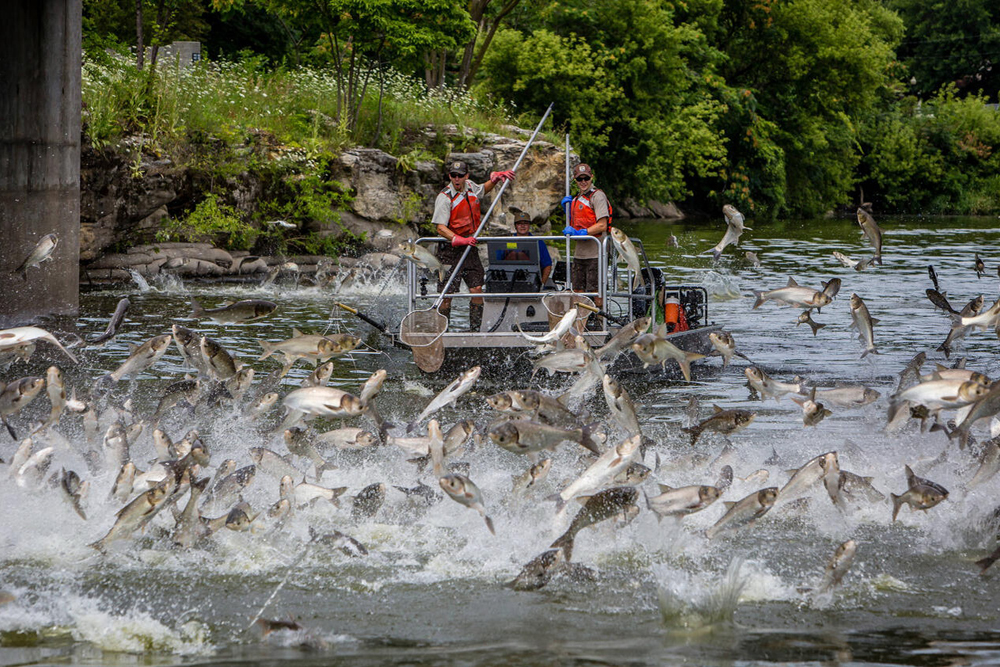
Thousands of invasive silver carp jump from the water as biologists attempt to
capture them from a specialized electrofishing boat. (Photo by Ryan Hagerty/USFWS)
Clearing a River of Invasive Carp
By Keith “Catfish” Sutton
If you’ve spent much time fishing big rivers for catfish, you’ve probably noticed changes over the years—fewer shad in some stretches, altered current seams and an increasing presence of fish that don’t belong there. Among the biggest culprits are invasive Asian carp, and in Kansas, fisheries biologists are finally gaining ground in the fight to reclaim prime catfish water.
Kansas Department of Wildlife and Parks (KDWP) biologists have removed more than 100,000 pounds of invasive carp from the Kansas River during the past four years, a milestone that signals real progress for one of the state’s most important fisheries. Since organized removal began in 2022, crews have taken approximately 109,000 pounds of carp from the river, with 2025 marking their most successful year yet—36,863 pounds removed in a single season.
The effort targets three invasive species now established in Kansas waters: silver carp, bighead carp and black carp. These fish were imported from Asia in the 1970s for aquaculture and escaped into Midwestern rivers decades ago. Since then, they’ve spread rapidly throughout the Mississippi River basin, outcompeting native species and reshaping aquatic ecosystems.
For catfish anglers, the impact is personal. These carp consume massive quantities of plankton and other microscopic organisms that form the base of the food chain. When that foundation erodes, baitfish populations suffer, and so do predators like blue, channel and flathead catfish that depend on them. Fewer shad and sunfish ultimately mean fewer healthy catfish.
“These removal efforts appear to have produced positive effects in Kansas waterways and for native species,” said Liam Odell, an invasive carp biologist with KDWP. Biologists are beginning to document population declines in targeted areas and the gradual return of native fish communities.
That’s good news for anglers who want rivers that grow big cats instead of rivers dominated by carp biomass.
Invasive carp also present a serious safety concern. Silver carp are infamous for their tendency to leap from the water when startled by boat motors, sometimes striking anglers and boaters. Bighead carp can grow to extraordinary size, with individuals exceeding 100 pounds. Anyone who fishes large rivers regularly knows how disruptive—and dangerous—these fish can be.
To combat the problem, KDWP has employed a combination of electrofishing, gill nets and specialized removal gear. In recent years, the agency added an electrified dozer trawl designed specifically for carp removal. The device stuns fish and funnels them into nets as boats move through infested stretches of river, allowing crews to remove large numbers efficiently.
In 2025, officials expanded the removal zone by an additional 15 miles downstream on the Kansas River. The Bowersock Dam in Lawrence continues to serve as a critical barrier, preventing carp from spreading farther upstream into waters that still support strong native fish populations, including catfish.
Kansas’ work is part of a much larger regional push to stop carp from overrunning the Mississippi River basin. In August 2025, the U.S. Fish and Wildlife Service announced nearly $19 million in funding for invasive carp management across 18 states, including Kansas. The funding supports large-scale removal, population monitoring and prevention strategies designed to slow the spread of these destructive fish.
For catfish anglers, these efforts matter more than many realize. Healthy rivers grow healthy catfish. When invasive carp dominate, they crowd out forage species and alter habitat in ways that make it harder for catfish to thrive. Removing carp helps restore balance, allowing shad, minnows and native fish to rebound and strengthening the entire food web.
KDWP officials say removal efforts will continue year-round and could expand further as funding and research allow. Odell also emphasized the role of the public in the fight against invasive species.
Anglers can help by never releasing invasive carp back into the water, even if caught accidentally, and by reporting sightings in rivers or reservoirs where these species have not yet been documented. Transporting live carp or using them as bait in new waters can unintentionally spread the problem and undo years of hard work.
Catfish anglers have long been stewards of America’s rivers. We depend on clean water, healthy forage populations and balanced ecosystems to produce the fish we love to chase. The massive carp removal effort on the Kansas River shows what can happen when agencies commit resources to conservation. And it reminds us that protecting catfish fisheries sometimes means removing the fish that don’t belong.
Every ton of carp hauled from the river is a step toward better catfishing tomorrow. And that’s a conservation victory worth celebrating.
(In 2022, Keith “Catfish” Sutton was one of the inaugural inductees into the American Catfishing Association’s Catfishing Hall of Fame.)
