

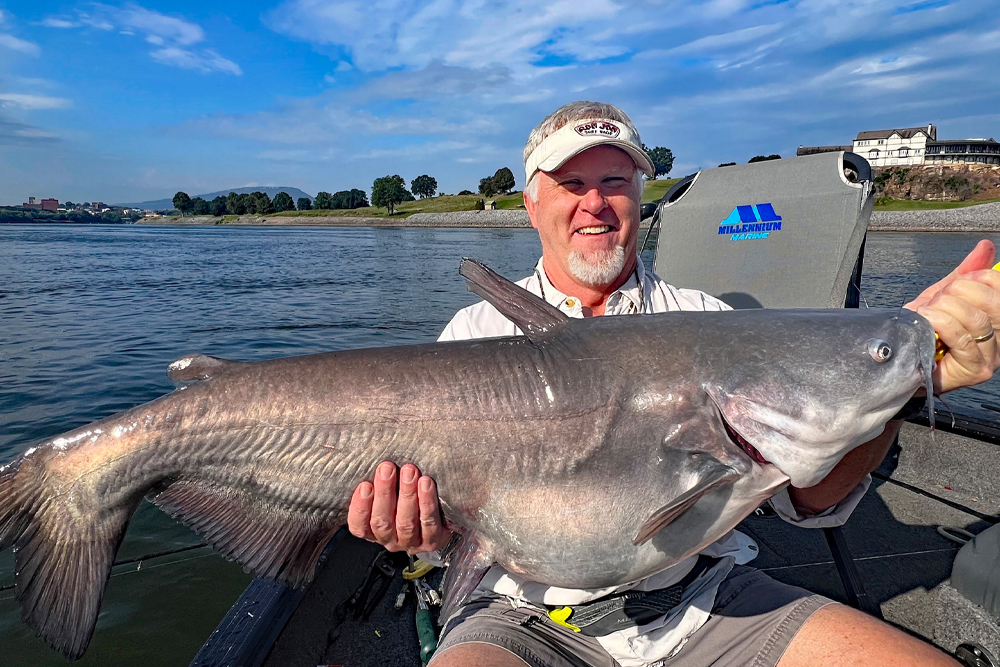
Like most catfishermen, Al Rogers often wonders whether or not using the right bait is the key to catching catfish, or whether the only thing that matters is putting any bait in the right place. BTW, this big blue was caught fishing with a chunk of chicken breast straight from the grocery store meat counter.
Does the Bait You Use Really Matter?
Story and photos by Capt. Richard Simms
Get two or more catfishermen together in the same room – or on the same Internet discussion forum – and I guarantee the discussion will either begin or soon turn to the subject of the “best bait.”
To kick things off here, I will walk out on a very thin limb and share that, “I don’t believe the bait matters.”
There, I said it.
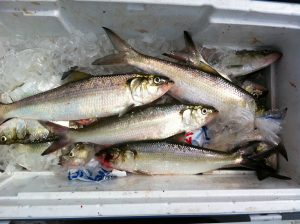
My opinion has always largely been that if you put dead (or sometimes live) meat in front of a hungry catfish, it will not sniff a bluegill or a sucker and say, “Nope, I’m hungry but I’m going to hold out for a dead shad instead.”
I don’t believe they are that discriminating. I set out to prove it with a guide friend one day and carried along some wild duck breasts that had been freezer burnt. My friend was fishing with cut shad, while I baited up with my old duck meat. I proceeded to catch the largest fish of the day and, if memory serves, I caught just as many as he did.
So, what is more important: the bait or the presentation/location of the bait?
I posed that question to multiple professional catfish guides across the country for their opinions. Here’s what they said:
Matt “Catman” Jones – Illinois Catfish Guide
“I disagree,” said Jones. “I’m from the North and target trophy flatheads. For me the type of bait is more important. On most trips, I can use large shad and, depending on the mood of the fish, I can use them live, dead or cut.
“At night when fish are on the move, I want a large live shad. I can’t get the movement and vibration out of other baits as I can a shad. Nor the attractiveness of a cut shad when fish are using scent to find food. I let the bait bring the fish to me.
“I do like a known nest robber during the spawn, like a bluegill. But as water temperatures cool into the 60s and below, fresh dead or cut shad is a better option.”
Capt. Ty Konkle – Tennessee Catfish Guide
“I’m split on this,” said Capt. Konkle. “I’ve seen many times where they will take about any bait presented. And presentation and location is more important because if you’re fishing in the wrong spot, it doesn’t matter what bait you use.”
But Capt. Konkle added, “At times, however, when the bite is finicky, they do seem to have a preference for a particular bait. For instance, my last trip out, I was suspending three different species of bait within 10 feet of each other. I had skipjack, gizzard shad and live bluegill. Eighty five percent of the fish caught were on the live bluegill. But other times, it doesn’t matter.”
Konkle did say that on a year-round basis, skipjack herring are his preferred bait. However, in recent years, skipjack have been much harder for catfishermen to locate on the Tennessee River. Sometimes he has found success using crappie. * (See footnote at end of article.)
“I think overall the best bait is whatever is most plentiful for the catfish at the time,” said Capt. Konkle.
Capt. Owen Koch – Washington, DC Catfish Guide
Regarding bait versus presentation, Capt. Koch said, “I think they are both important. It’s not a binary question. For example, I’ve had days when fish won’t touch certain baits over others fished on the exact same type of rigs. I’ve also had no bites, for example, on floating rigs, but as soon as I take the floats off, the fish start eating. Both are worth experimenting with and changing up when the fish aren’t biting.”
He does say his best baits vary based upon the season.
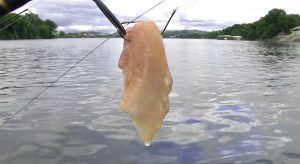
“Gizzard shad is the best all-around bait in the tidal Potomac River. Plus, it is readily available year-round. However, I’ve done well with bluegill in the warmer months, white perch* in the spring when they’re running upriver, and carp usually produces bites. My take is, feed ’em what they’re used to seeing. If I get in a bind and have to use grocery-store baits, I’ll buy anything cheap and oily—mackerel and mullet, for example.”
Capt. Terry Rogers – Catfish Guide on Mississippi & Ohio Rivers
Capt. Rogers said, “Presentation and the bait itself, I believe, are equally important at times. Bait versus presentation will always vary according to time of year, water conditions, weather conditions and several other factors. In my opinion, there will never be a definitive answer regarding the bait versus presentation argument. But for the most part, I lean towards the bait itself being more important.”
“I fish mostly with cut skipjack for big blues and notice a discernible difference between fresh bait and old/older bait. Fresh bait is always better than old bait, no matter what the situation. Presentations can be changed up at will to adjust to conditions.
“I’ve never had any real problems finding skipjack. There are several areas around my area that hold skipjacks year-round. After fishing for them for a while, you get to know their patterns and areas they will hang out in at different times of the year, making them a lot easier to find and target.”
Capt. Brad Durick – Channel Catfish Guide on Red River (ND & MN)
“I used to agree wholeheartedly (that presentation was more important than bait),” said Capt. Durick. “When I did a lot of speaking, I would always say, ‘I will ask you what the best bait is and get 10 different answers.’ I felt a good piece of bait in the right spot is more important than what that bait actually is.
“My philosophy has gotten much deeper than that the past few years as I stumbled into aging bait to find what level is most effective. What I have found is that putting the bait in the right spot is critical, but you can increase catch rates by a lot if you have what they want and have it aged to what they want.”
Capt. Durick fishes exclusively for channel catfish in the Red River and says that white sucker is his go-to bait.
“It is one that I have been able to buy and keep on hand in my bait tanks until l need to use it. We also use goldeye and, seasonally, leopard frogs,” he added. “I use sucker all year long. I find the fish want goldeye like three or four days per year, so I always keep a little. If we have a very dry spring and the water holes are dry causing less of a frog crop, they are not a bait of choice in late summer. If we have a wet spring and a lot of frogs, the catfish zero in on them at night, and they become a bait of choice.
Capt. Durick keeps meticulous records on his catch rates.
“I have come to the conclusion that fresh (bait) is not always best. I have increased my catch rates for a season by nearly 1.5 fish per hour since I have changed over to this way of thinking. I have tested aged vs. fresh bait side-by-side a few times with unbelievable results.”
But in the end, Capt. Durick said, “Having that bait in the right spot is still a key to success.”
Jimmi Brown – Central Iowa Catfishing Guide
In his reply, Brown avoided the primary question regarding presentation versus bait. He did say, however, “I personally believe water temperature is the most important aspect for me when targeting channel cats. Fresh bait is my preference, however, freshly frozen or iced bait work in a pinch.
“When the water warms up, the channel cat’s diet changes. During the winter they forage for winterkill fish, grubs, snails and worms. At ice out and warmer months, they switch to eating live fish. They become very aggressive, and they chase the schools of baitfish.
“In Iowa, we can use any fish that has been legally harvested via rod and reel. We must follow length limits if they are posted or stated in the rules. During ice out and early spring, we use creek chubs, shad chunks and shad guts. In the summer, it’s shad, bluegills and crappie.* In the fall, I go to large cut-bait such as shad chunks and fish heads.”
*Regarding the use of crappie, or other gamefish: Regulations vary widely state to state for using gamefish as catfish bait. For instance, in Tennessee, crappie can legally be used as bait if they are caught via rod and reel. However, there is a 10-inch minimum size limit on crappie. So, while you can use them as catfish bait, another regulation says it is illegal to disfigure any fish while on the water to the point its species or legal length cannot be determined. That means if you cut a legal crappie into pieces, a game warden could potentially cite you for disfiguring that fish so he can’t determine if it was of a legal length.
ALWAYS consult your local regulations regarding the use of gamefish as bait.
(Capt. Richard Simms also writes for our sister magazine, CrappieNOW. He is also a “semi-retired” fishing guide on the Tennessee River and owner of Scenic City Fishing Charters. Formerly, he was a game warden for the Tennessee Wildlife Resources Agency before becoming a photographer and PR guy for TWRA. That led to a 30-year career as a broadcast journalist and freelance outdoor writer. Check out his book, “An Outdoor State of Mind.”)
