

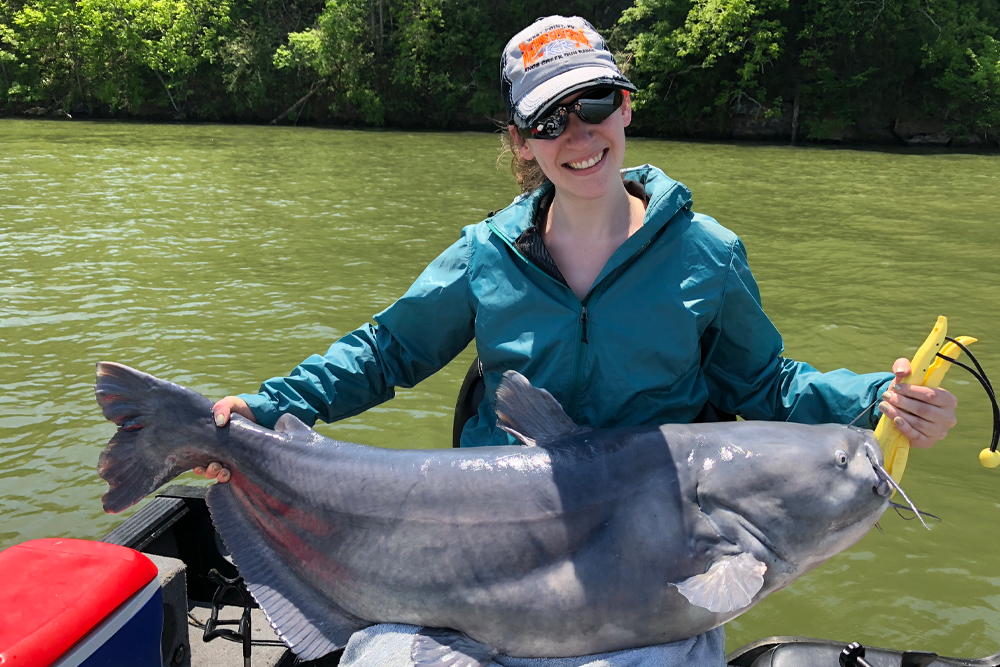
After battling this 65-pound trophy blue cat on the Tennessee River’s Chickamauga
Lake, Krista Slager had an excellent understanding of why the area is considered
by many to be a “catfish factory.”
The Tennessee River: A Catfish Factory Backed by Science
Story and photos by Capt. Richard Simms
We live in a world of artificial intelligence, better known as AI. Ask AI anything you want and you can become an instant expert. That why I asked it to “Please list the best catfishing rivers in the United States.” Here’s what it said:
#1 – Mississippi River
#2 – Missouri River
#3 – Ohio River
#4 – Tennessee River
Now AI always admits, “I can get it wrong sometimes so crosscheck me,” or words to that effect. Therefore, I’m sure lots of people are looking at that list and vehemently saying, “You got it wrong, AI,” perhaps in stronger language that includes the letters B and S.
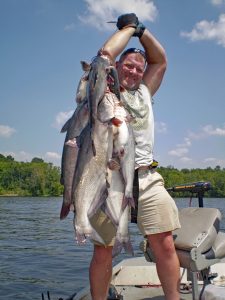
I, in fact, would argue the Tennessee River should be higher on the list. But I am admittedly heavily biased because I’ve fished the Tennessee River almost exclusively for more than six decades. I am, however, bolstered in my argument by AI itself, which added a footnote saying the Tennessee River is “the best all-around river system in the Southeast.”
In 20 years as a professional catfish guide on the Tennessee River, I routinely tell clients, “The Tennessee River is a catfish factory.””
Tennessee fisheries biologists do not disagree.
“I think that’s a fair assessment,” said Patrick Black, fisheries biometrician for the Tennessee Wildlife Resources Agency. (A biometrician is the guy who takes raw field data like fish surveys, netting results, electrofishing catch rates, etc. and turns it into scientific conclusions about fish populations.)
“I don’t know where we rank (on catfishing)) compared to other Southeastern rivers,” Black continued. “But based on size and productivity, I’m sure the Tennessee River and its reservoirs would rank fairly high.”
Part of the scientific data Black is looking at to make that determination is creel surveys, the information collected when TWRA creel clerks conduct on-the-water surveys of anglers. To include information on the Tennessee River in East Tennessee and West Tennessee, I asked Black to compare Chickamauga Lake and Kentucky Lake. The last time creel clerks surveyed both reservoirs in the same year was 2024.
Black said, “In 2024 the total numbers of catfish caught in Kentucky Lake were 65,778 blue catfish, 76,662 channel catfish and 881 flathead catfish.”
Meanwhile, in Chickamauga Lake he said, “There were 17,697 blue catfish, 12,223 channel catfish and 823 flathead catfish.”
Keep in mind, however, that Kentucky Lake is four times larger than Chickamauga, which means per surface acre, there were actually more blue catfish and flatheads caught in Chickamauga, but far fewer channel catfish.
Either way, the scientific surveys reveal the entire Tennessee River system is indeed, “a catfish factory.”
Capt. Sam Simons has been a catfish guide on the Tennessee River for about 17 years. He said, “When I think about the three best catfishing waters, I think about the Tennessee River, the James River and the Mississippi River. I think you could argue over which one is number one based on your regional location and preference over size and quantity. But I just know I’ve caught a lot of catfish of various sizes from six of the nine Tennessee River reservoirs (and haven’t fished the others).”
Of course, the Tennessee state-record blue catfish was caught on the Cumberland River. Micka Burkhart landed the huge fish on Barkley Reservoir in Stewart County. It hit the scales at 122 pounds, 3 ounces and was 57.5 inches in length with a girth of 42.5 inches.
But is the Cumberland River a catfish factory?
TWRA Region III Fisheries Biologist Mike Jolley said, “I can only speak for Region 3, but the Tennessee River typically produces more numbers and opportunities for big fish overall than the Cumberland River system.”
Black added, “In the Tennessee River system, blue catfish are the most abundant catfish species caught in all reservoirs between Watts Bar and Kentucky Lake. In the Cumberland River system, they are the most abundant in Barkley Lake (the farthest reservoir downstream). There are a lot of river miles in the Tennessee River system that offer preferred habitat for blue catfish.”
Jolley said Tennessee River habitat includes, “Excellent forage bases of shad species, bluegill, etc., good thermal refuges in the reservoirs such as deep river holes and shoals, good water quality and evidently great spawning habitat. There are minimal catfish-disease-related die-offs compared to catfish held in captivity.”
As far as the number of catfish anglers catch per each hour fishing, Kentucky Lake comes in higher than Chickamauga. In 2024, anglers caught 0.7 catfish (all species) per hour, while in Chickamauga catfish anglers caught 0.45 per hour. However, those numbers were influenced by the significantly higher population of channel catfish in Kentucky Lake. Comparing blue catfish only, the catch rates in both lakes were similar.
For hardcore catfish anglers, those catch-per-hour numbers may seem incredibly low. But TWRA’s scientific surveys include all experience levels, from complete novice anglers to experts.
For many of my own years as a professional catfish guide, I kept my own catch-per-hour records. Every year my clients caught from 2.75 up to three catfish per hour. So as for your catfish-catching statistics, as the saying goes, “Your mileage may vary,” depending upon your own expertise, or luck.
Regardless, the Tennessee River is a place you want to be.
(Capt. Richard Simms is a retired fishing guide on the Tennessee River and owner of Scenic City Fishing Charters, booking trips for eight other catfish and bass guides. Formerly he was a game warden for the Tennessee Wildlife Resources Agency before becoming a photographer and PR guy for TWRA. That led to a 30-year career as a broadcast journalist and freelance outdoor writer. Check out his book, “An Outdoor State of Mind.”)
