

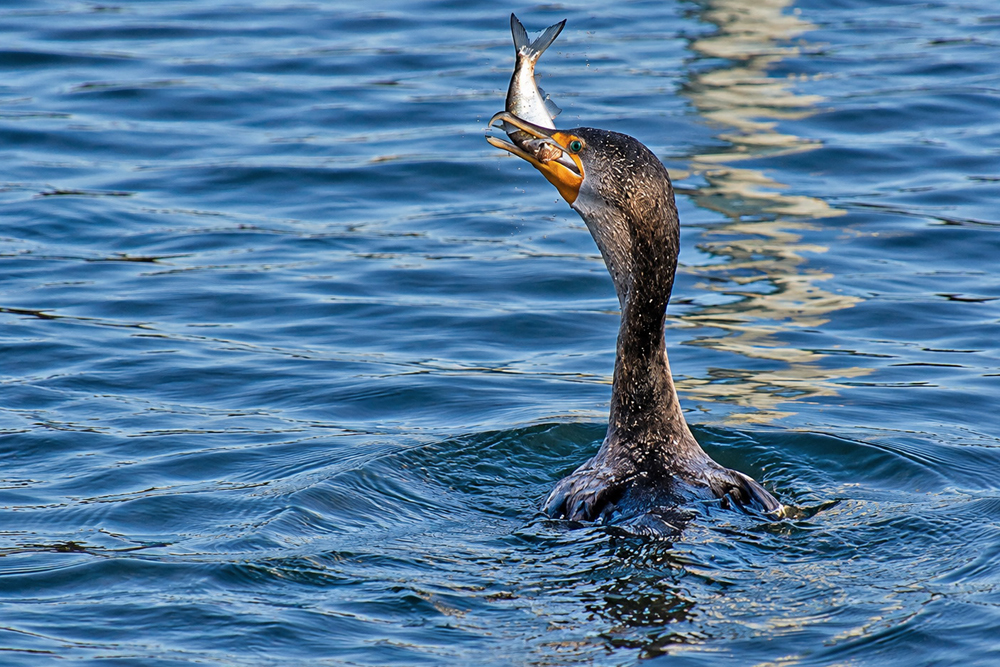
Double-crested cormorants are efficient fish predators, but large
concentrations can create significant challenges for catfish farmers
and fisheries managers. (photo by Keith Sutton)
New Legislation Takes Aim at Cormorant Management
By Keith “Catfish” Sutton
Double-crested cormorants are nothing new to catfish farmers, anglers or fisheries managers. The fish-eating birds have been a management concern for years, particularly in areas where large numbers gather around fish farms, lakes and other productive waters.
Now, a new piece of federal legislation could change how those birds are managed.
U.S. Sens. Ted Cruz of Texas and Katie Britt of Alabama introduced the Responsible Cormorant Management and Control Act of 2026 on September 24. The legislation would require the U.S. Department of the Interior to develop regional management plans for double-crested cormorants. A companion bill, H.R. 8195, was introduced in the House by Rep. Tim Walberg of Michigan and was advanced by the House Natural Resources Committee on September 15.
For catfish producers, the issue is familiar: cormorants eat fish, and large concentrations of the birds can create significant losses.
A fish-eating bird with a big appetite
Double-crested cormorants are native waterbirds found across much of North America. Their numbers increased substantially during the second half of the 20th century, following improvements in environmental conditions, restrictions on pesticides such as DDT and changes in wildlife protection and management. The U.S. Fish and Wildlife Service currently estimates that between 871,001 and 1,031,757 double-crested cormorants occur in the continental United States and Canada.
Cormorants are efficient underwater predators. That’s normally a good thing; they are part of the natural ecosystem and have always eaten fish.
The problem comes when large concentrations of birds feed repeatedly in places where fish are concentrated and especially vulnerable. That includes commercial catfish ponds.
A 2021 study of catfish farms in the Mississippi Delta found that producers spent an average of $704 per hectare trying to scare birds away. The study estimated that the value of catfish lost to cormorant predation averaged $47.2 million annually. When the costs of deterring the birds were added, the total direct economic impact averaged $64.7 million a year, with the actual figure varying considerably from year to year.
Those numbers help explain why cormorants remain an important issue for the catfish industry.
What would the new bill do?
The Responsible Cormorant Management and Control Act takes a different approach from simply setting one nationwide rule. Instead, it would direct the Interior Department to work with the nation’s regional Flyway Councils to establish regional management frameworks for cormorants. Those frameworks would be designed to keep breeding populations at sustainable levels while taking into account the effects of cormorants on fisheries and other natural resources.
The legislation also calls for identifying entities that could be authorized to take cormorants under the regional frameworks. That could include state-licensed lake and pond managers.
In plain English, the goal is to give wildlife managers more flexibility to deal with problem concentrations of birds rather than treating every situation exactly the same.
The bill does not establish an immediate nationwide cormorant-control program. It would create a framework under which regional management plans could be developed.
That distinction is important because double-crested cormorants are protected under the federal Migratory Bird Treaty Act. Current federal rules generally require authorization for taking the birds when they are causing damage.
This isn’t the first attempt
The legislation also follows several years of efforts to give aquaculture producers more options.
In 2025, Congress considered the Cormorant Relief Act, which sought to reinstate an older federal depredation order that had allowed certain aquaculture operators to take cormorants without obtaining individual permits. That earlier order was vacated by a federal court in 2016, returning affected producers to a permitting system.
The 2026 legislation takes a broader approach. Rather than focusing only on aquaculture facilities, it addresses cormorant management on a regional basis and considers impacts on fisheries and other natural resources as well.
That could make the issue relevant not only to catfish farmers but also to fisheries managers and anglers in areas where cormorant numbers are high.
Finding the balance
There is little question that cormorants are capable of eating a lot of fish. There is also little question that they are a native part of North America’s wildlife.
The conservation challenge is finding the point where those two facts can coexist.
Good wildlife management isn’t necessarily about eliminating a species. It’s about keeping populations and their impacts within levels that ecosystems and human activities can sustain.
That’s essentially what the new legislation proposes: a regional, science-based approach that considers both cormorant populations and the fisheries they affect.
The bill still has a long way to go before becoming law. For now, it represents another step in a continuing debate over how best to manage double-crested cormorants and how to protect the fish resources that support recreational anglers, commercial fisheries and America’s catfish industry.
(Keith “Catfish” Sutton of Alexander, Arkansas serves as editor of CatfishNOW and its sister publication, CrappieNOW.)
