

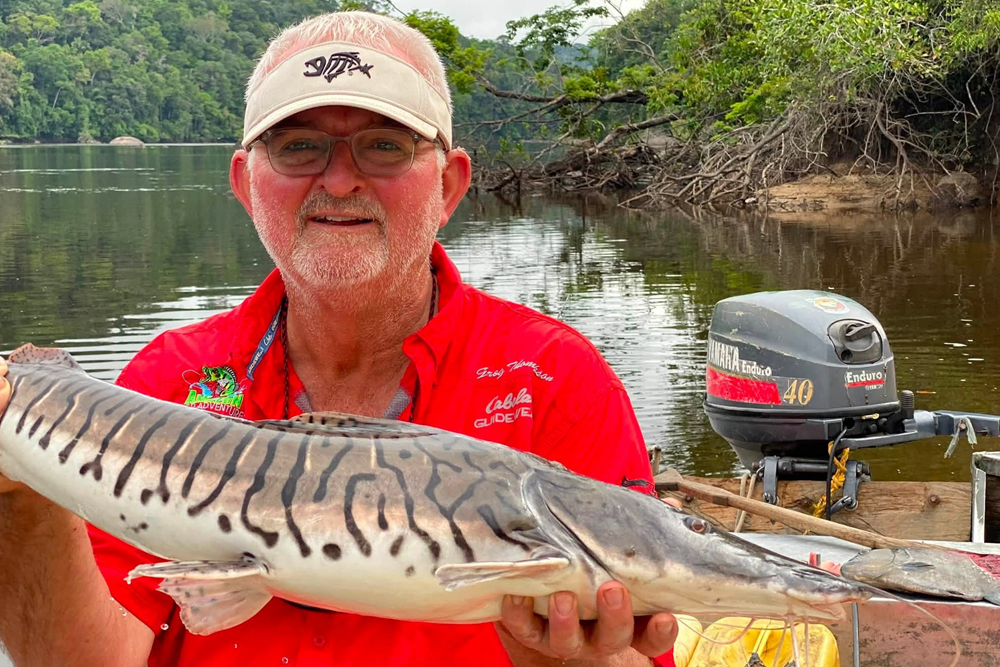
Greg Thompson poses with a surubim catfish caught in Guyana.
A World-Wide Approach to Catching Big Catfish
By Brent Frazee
Photos courtesy of Greg Thompson
Greg Thompson knew he wasn’t in Missouri anymore when he got an unusual trade offer for one of the lures he was using to catch fish.
Deep in the backcountry of Venezuela, he used a Rat-L-Trap to enjoy a banner day on the Cinaruco River. That night, two tribesmen approached Thompson’s guide with an offer from the chief.
“He wanted to trade me one of his daughters for the lure I was using,” said Thompson, 67, a retired autoworker from Liberty, Missouri. “I turned him down, but I gave him some of the lures anyway.”
The following day, Thompson received a big thank you from the chief. He sent the tribesmen back to lead the Missouri fisherman on an unforgettable adventure.
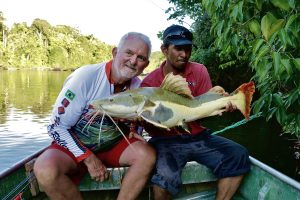
They traveled six river miles by boat, then hiked a short way to a hidden gem in the jungle.
“I caught a 13-pound peacock bass on my first cast,” Thompson said. “It was like a little paradise.”
Such is life for a globetrotting adventurer like Thompson. He is no longer content to fish the close-to-home waters of the Midwest. He wants to explore the world with a fishing rod in his hands.
His quest started years ago when he watched television fishing show celebrities such as Jimmy Houston fish for peacock bass in exotic locations, and he dreamed of doing the same thing. Before long, he arranged affordable trips to Venezuela and Brazil. From the first time he set the hook on one of the hard-fighting peacocks, he was hooked.
Fast-forward to 40 years later, and he has traveled to more than 20 countries and has caught 400 different species of fish. And he is still going.
He has taken more of a multi-species approach in recent years, and he has enjoyed casting for many gamefish, including various species of freshwater catfish in exotic locations.
“I love seeing different cultures, eating different foods, but I’m not a tourist,” Thompson said. “Most of the time, I want to be as far from civilization as I can get.”
He has caught catfish in places such as Brazil, Venezuela, Guyana, Thailand and Vietnam, and each experience reminded him that he wasn’t in America anymore.
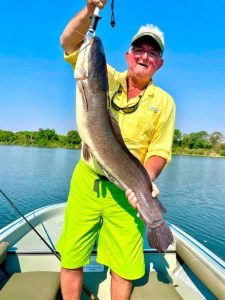
He remembers seeing elephants along the bank of the Chobe River in Namibia and the Zambezi River in Africa as he reeled in big redtail catfish.
“Redtail catfish are a big part of their diet in Guyana,” Thompson said. “If someone caught a 30-pound fish, our guide would keep it and feed everyone in camp with it that night.”
Thompson also remembers setting up a food chain to fish for Chao Phraya catfish in Vietnam.
“We would fish for tilapia with a piece of cinnamon roll, then use the whole fish for bait,” Thompson said. “We caught some nice fish that way.”
He also remembers catching vundu catfish while trolling for tiger fish on the Chobe River and fishing with chicken hearts on the Zambezi River in Africa.
One of his most memorable trips came when he fished for Mekong catfish on a private lake near Bangkok, Thailand. Though some purists in America look down their noses at pay lakes here, they are widely accepted in Thailand, Thompson said.
“On weekends, it’s a family affair.,” he said. “They go fishing for the day, eat their meals there, just enjoy the outdoors.”
The fishing is far different than what you will see in the United States, too.
“They use an egg-shaped wire container and fill it with homemade doughbait, then put a hook in it,” Thompson said. “You cast it out, and that dough bait immediately starts leeching out into the water. It doesn’t take long for the catfish to find it.”
Along the way, Thomson has had to watch for electric eels in trees along bodies of water in Venezuela and schools of aggressive piranhas in other spots.
He lived in primitive housing in some countries, though he didn’t look at it as “roughing it.” Instead, he enjoyed witnessing various cultures.
“Some of the boats I have slept on had a black water tank on top,” he said. “During the day, the sun heats the water, and we had warm water to take a shower. They worked with what they had. But they’ve always been very aware of making us as comfortable as possible.”
And the language barrier?
“Some of the guides can speak English, but a lot of them can’t,” Thompson said. “But I’ve always felt that fishing is a universal language. I’ve never had trouble communicating with a guide when I’m out there fishing.”
(Brent Frazee is an award-winning writer and photographer from Parkville, Mo. He served as the outdoors editor of The Kansas City Star for 36 years before retiring in 2016. He continues to write for magazines, websites and tourism offices.)
