

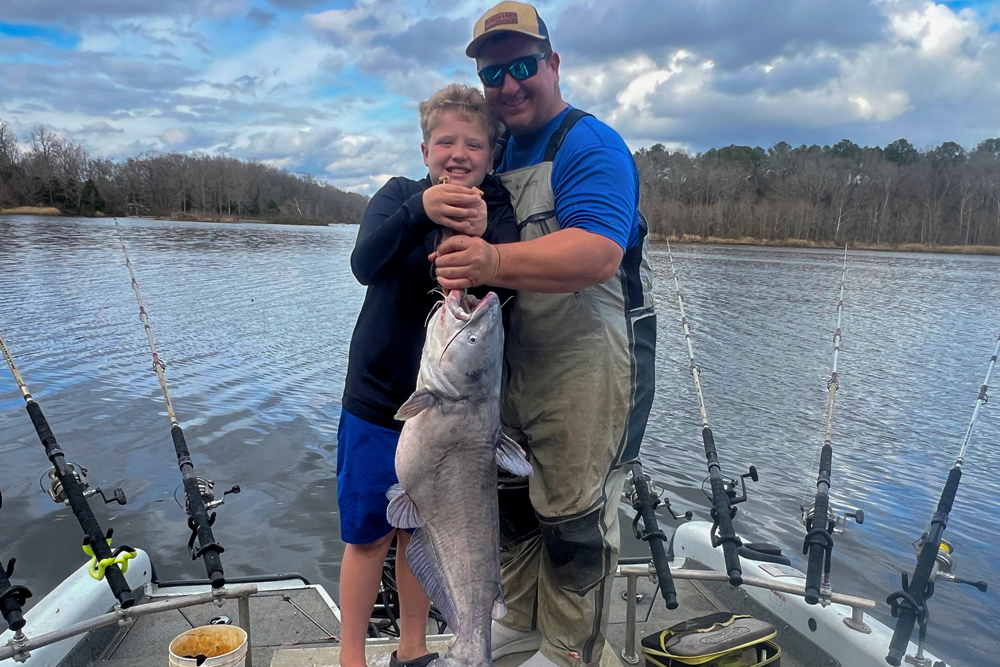
Joey Pounders and his son Leaf with a blue catfish
caught on the Alabama River. (Joey Pounders photo)
Alabama River Trifecta
By Anietra Hamper
Fishing the Alabama River offers something rare in today’s heavily pressured angling world: the chance to catch all three major catfish species in a river system that still feels largely undiscovered. The opportunity to catch channel, blue and flathead catfish in a single trip is one of the things that makes this river special.
Seasoned catfish angler Joey Pounders is a tournament competitor and on the pro staff for B&M Poles, Driftmaster Rod Holders, TTI-Blakemore and Betts Tackle, so he knows a thing or two about successfully targeting catfish. Pounders lives in Caledonia, Mississippi with several great river systems nearby, but he’s willing to drive several hours to fish the Alabama River because of a few secrets and tips for targeting each species that he shares with CatfishNow.
A Hidden Gem for Catfish Anglers
While famous fisheries like the Tennessee and Coosa river systems get most of the attention, Pounders believes the Alabama River quietly outperforms them for several reasons.
“I think it’s a hidden gem,” Pounders says, pointing to the lack of fishing pressure as a major advantage. With fewer anglers targeting catfish, the fish simply don’t see as many baits.
The river’s structure is another standout feature.
“When I look at [that] river with plenty of depth, blue rock and sand banks, I wouldn’t pass that river up,” Pounders says.
Deep holes, scattered throughout long stretches, create ideal habitat for catfish. Unlike rivers where a few popular spots get heavy fishing pressure, the Alabama River offers holes all the way up and down, meaning anglers can find productive water almost anywhere.
Pounders points to several stretches on the Alabama River as being especially productive for fishing. These include stretches around the Alabama Riverwalk in Montgomery by Riverfront Park to the Highway 65 bridge, and the riverbend near Cat Hollow. Both areas have an abundance of blue rock. He also recommends fishing upriver a few miles towards Millbrook and along the wall near One More Lounge, also in Millbrook.
When you add in that the river system also has an abundance of bait, particularly shad, it becomes clear why Pounders is willing to make the drive to fish there.
Channel Catfish: Target the Gravel
Pounders emphasizes that anglers should focus on gravel, not rock walls, when chasing channel catfish.
“Channel cats stay on a gravel bar more than they do on a blue rock wall,” he says.
These fish typically hold in five to 15 feet of water, especially along gravel banks rich with mussels, which are a key food source. Pounders recalls finding mussels “as big as my hand” in these areas, a clear indicator that channel cats won’t be far away.
Bait choice matters just as much. Unlike flatheads, channel cats respond better to smaller offerings. Pounders recommends using cut-bait such as shad fillets or heads on a 5/0 hook. “You have to have a bait small enough for them to take,” he notes, cautioning against the oversized presentations many anglers use out of habit.
Flathead Catfish: Hunt the Blue Rock
Flathead catfish are a different game entirely, and the Alabama River may be one of the best places in the Southeast to target them near the dark clay or rock-bottom areas.
“Those flatheads are running that blue rock,” says Pounders. “If you can find a 25- to 45-foot hole with an isolated tree, you’re golden.”
Live bait is essential when targeting flatheads. Shad is Pounders’ top choice, though small drum or bream can also work. The key, however, is mobility. Pounders rarely stays in one spot for long.
“If he’s not biting in 20 or 25 minutes, he’s not going to, so, I just move,” he advises. In a single outing, Pounders might hit a dozen or more spots until he finds active fish.
Blue Catfish: Adapt and Experiment
Blue catfish in the Alabama River can be less predictable, often sharing similar habitat with flatheads.
“They like to hang out in the same holes as the flatheads in that river,” Pounders says, though he notes that the two species don’t always coexist closely.
One common misconception is that blues only prefer cut-bait, but Pounders disagrees.
“Everybody thinks blue cats only bite cut-bait, but they’re wrong,” he says. “I catch just as many blue cats on live bait.”
Because of this, he often improves his chances by fishing multiple rods with different bait types. “If I have six poles, I might put different baits on them,” he explains. “I’ll go five with live bait and maybe one cut-bait on the low side.”
This approach helps him dial in what the fish want on any given day.
Certain stretches of the river, such as areas near current breaks and rocky banks, can hold concentrations of blue cats, but Pounders says that anglers should stay flexible. If a spot isn’t producing, he moves even if it means going miles downriver to start fresh.
The Importance of Bait and Presentation
No matter what species you want to target, bait quality is paramount. Pounders is adamant that lively bait dramatically increases success, which is why he prefers using a cast net to catch shad. Healthy, active bait creates vibration and draws attention, while weak bait goes unnoticed.
“If you put two shad in there, one that’s lively and one that’s not, they’re going to pick the lively one,” he says.
To maximize effectiveness, Pounders recommends elevating live bait off the bottom using a three-way rig.
“If you elevate him, you’re going to get some vibration out of him,” he says. This not only makes the bait more visible but also prevents it from lying motionless on the riverbed.
Pounders also uses longer 10-foot rods to improve presentation. Instead of casting hard, he gently tosses baits into position.
“I’m kind of finessing my throws instead of slinging it,” he says. “That helps the bait stay alive.”
Chasing the Alabama River Trifecta
While it’s possible to catch all three species in a single trip, Pounders suggests focusing on one at a time for the best results. Still, the diversity of the river makes multispecies days a possibility.
“I think you could accidentally catch three different species there,” he says.
If forced to choose, he’d prioritize flatheads due to their strong numbers in the system.
Ultimately, the Alabama River rewards anglers who are willing to explore, adapt and put in the effort, especially when it comes to catching fresh bait. For those who do, the payoff can be exceptional fishing in a place that still flies under the radar for many catfish anglers.
(Anietra Hamper is a career television news anchor and investigative journalist turned award-winning outdoor writer specializing in fishing and outdoor adventure. Anietra travels the world fishing for catfish and other unique species in new destinations.)
