

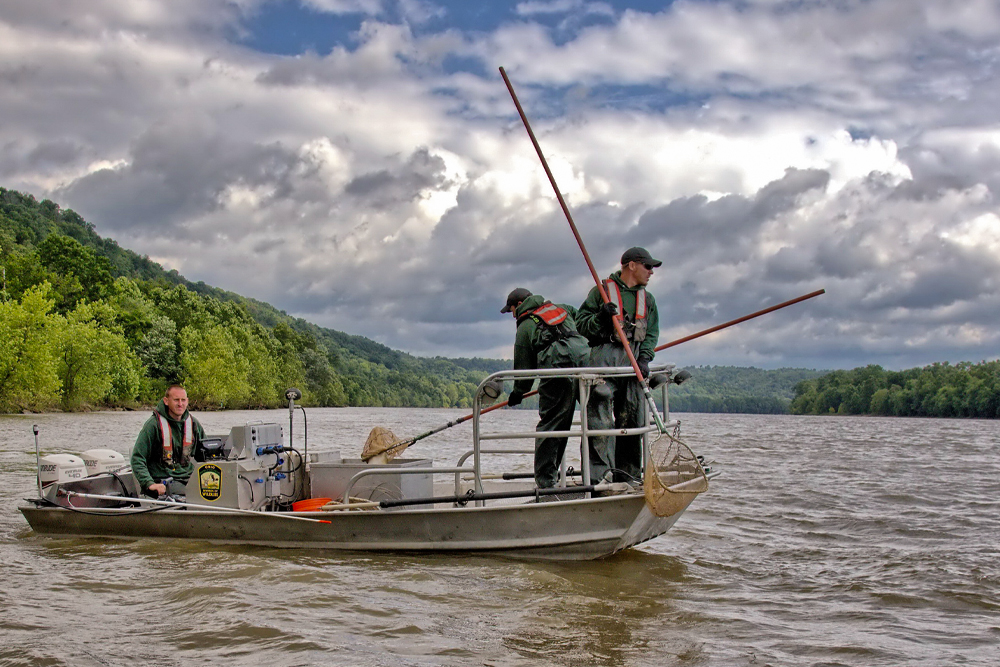
Fisheries biologists with the Ohio Department of Natural Resources are in the process
of collecting blue catfish so they can equip these cats with transmitters to monitor
their movements along the Ohio River.
Blues on the Move
By Richard Hines
Photos courtesy of the Ohio DNR
Sitting around the dock or at your local coffee shop, you no doubt have learned a lot about catfish. But thanks to science, we are beginning to learn more facts about these whiskered creatures. The new information doesn’t come from just one research project but dozens. Each provides small pieces to the puzzle, allowing us to learn more each year.
One of these research projects was on the Ohio River.
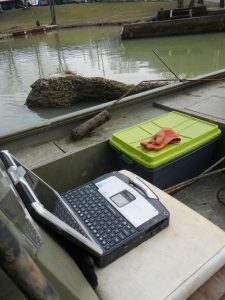
As an old, retired biologist, it didn’t take me long to realize technology is quickly running by me. Radio telemetry has been around for several decades, but like everything else, the technology gets better by the day. In my day, we had to be on site every day collecting data while wielding large bulky Yagi antennas to locate our study subjects. However, today’s data loggers can receive information 24/7 at multiple locations.
To learn more, I talked to the man in charge, Jeremy Pritt, who is a fisheries biologist for Ohio Department of Natural Resources (DNR). Pritt and I talked shortly after the agency just wrapped up a multi-year project monitoring movements of catfish. During the project, biologists equipped 72 blue catfish and 73 flathead catfish with transmitters, simultaneously collecting data on both species.
Basically, it seems the blues were the movers. And while some were covering lots of water, a few individual blues were content to stay in one place for months on end. Of the 72 fish, it was not unusual for a blue to put 100 miles on their odometer, traveling both upstream and down.
Pritt said, “Of the 72 blue catfish we tagged in the Meldahl Pool (between Meldahl and Greenup dams), nine blues were able to move downstream past the Meldahl Dam … six of these moved back, but none moved upstream past the Greenup Dam.
There were distinct differences between blue cats and flatheads. Two of the flatheads made passage past the dams, well above the Greenup Dam. Some of these 100-mile trips were completed within two weeks!
Keep an Eye on High Water
No doubt you and other anglers have already guessed that high water increases movement up smaller tributaries. During all high-water conditions, blues moved up tributaries, and much further than anyone suspected. The higher the water, the further their movement upstream. One tributary, the Scioto River, was a favorite travel destination for blues during high water. One blue moved well over 20 miles upstream.
If you are wondering when to fish, keep an eye on river gauges. Anytime there is a large “bump” on the river or any tributaries, you can bet blues are taking advantage of this new water.
I told Pritt, I always classified blue cat water as “towboat water.” In other words, larger rivers. But he told me this is not necessarily true because blues will quickly exploit food sources in temporary water.
Other tributaries where Pritt and his crew conducted research demonstrated that blues are not only moving into the lower reaches of these smaller rivers, but in some cases, moving upstream well beyond large riffles or shoals. This demonstrates that they can handle faster currents.
Dam Passage
Ohio researchers found several blues moving between dams, which required blues to find a route through the dam. Pritt said dam passages occur in two ways— through locks (when boats are locking through) and under the bottom of flood-control gates when the current is slower. Which dam they move through depends on river conditions, dam operations and the dam’s construction. This shows that dams are partial as opposed to total barriers for catfish passage.
Several years ago, in a totally different study, researchers found many species of fish, including catfish, had the ability to pass through some of the dams along the upper Mississippi River. These factors did varied according to the design of the dam. Of the fish that did pass, about 70 percent did so when lock gates were open or there was some type of opening that easily allowed fish to pass. In some cases, fish navigated through flood gates with average openings of only 23 to 47 inches.
Other Interesting Tidbits
One thing that stood out in this study was the travel aspect. Blues are movers, and a 100-mile journey is nothing.
Everyone has always assumed that catfish movements were driven by seasons, but these movement patterns are not always tied to any one season. And this has been hard to pin down, creating more questions than answers.
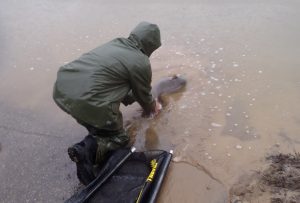
Of the tagged fish, Pritt and his fellow researchers found several blue cats hanging out in the same place for well over a year. Pritt said, “We thought the fish had shed its tag or may have been dead … there was almost no movement.”
Pritt noted that blue catfish are obviously individuals, each with different patterns. “They don’t do the same thing at exactly the same time as is the case with many other species of fish,” he noted.
Blues Are Tricky Subjects
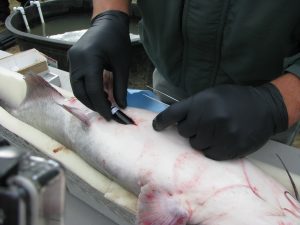
Today, researchers can monitor many species of fish, but it seems blues are a tricky lot because of their ability to shed surgically implanted tags. If the delicate procedure is not preformed correctly, it may kill the fish.
Pritt said, “Even though tags are surgically implanted into the abdomen of the fish, they are sometimes able to absorb the tag into the intestine, at which point the tag just passes on through the digestive system. Some tags stayed in place for a couple of years, while other catfish absorbed tags within a couple of months.”
This research study on the Ohio River is one of many projects that are helping biologists learn more about our favorite quarry along the nation’s big rivers.
(Richard Hines is a retired wildlife biologist, book author and award-winning freelance outdoor writer and photographer. Since 1985, Hines has published hundreds of articles on hunting, fishing, conservation and natural history.)
