

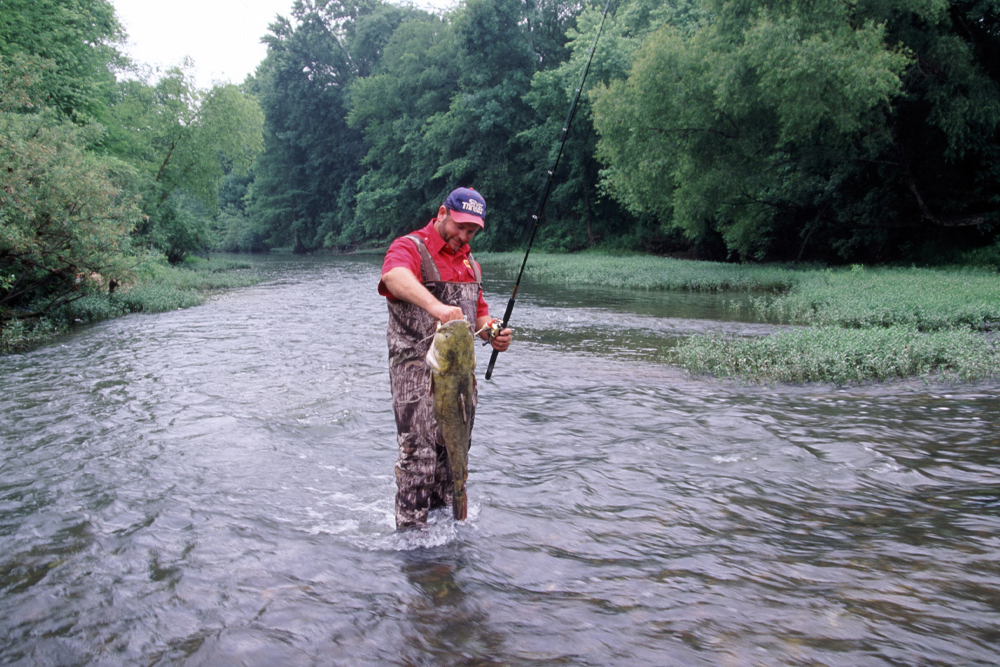
Catfish Basics: Mountain Stream Catfish
Story and photo by Keith “Catfish” Sutton
When most catfish anglers picture their next trip, they imagine muddy rivers, sprawling reservoirs and backwater holes buzzing with mosquitoes. Few think about cool, clear mountain streams.
That’s a mistake.
Across much of the country, mountain streams support surprisingly healthy catfish populations. In my home state of Arkansas, for example, surveys have shown channel catfish inhabiting nearly every cool-water stream examined. Flatheads thrive in many of the same waters, and some streams even harbor blue cats. Similar opportunities exist in mountain regions from the Ozarks and Appalachians to the Rockies.
Better yet, these overlooked fisheries often receive little catfishing pressure.
Mountain stream cats may not always match the sheer numbers found in big rivers, but they make up for it with aggressive strikes, beautiful surroundings and the very real possibility of hooking a trophy. Some of the biggest flatheads I’ve seen have come from waters more commonly associated with smallmouth bass and trout.
The key to success is understanding how catfish use stream structure. Most mountain streams follow a repeating pattern of riffles, holes and pools.
Riffles are shallow stretches of broken water flowing over rock or gravel. Because the current is swift and oxygen levels are high, these areas attract baitfish and other prey. Catfish move through riffles and occasionally feed there, especially during low-light periods.
Immediately below the riffles are deeper holes. These are prime catfish locations. Current scours the streambed, creating depressions that provide depth, security and relief from the strongest flow. Think of holes as a catfish’s home base.
Within these holes, the deepest sections often serve as resting areas. The upper end, where current delivers food, becomes the dining room. Logs, boulders, root wads and other current breaks near the upstream portion of a hole are especially attractive because catfish can hold there while waiting for prey to drift within reach.
Below the holes lie the pools—longer, slower stretches with relatively uniform depth. Catfish travel through pools while moving from one feeding area to another and may spend time there under favorable conditions, but holes generally produce the most consistent action.
One of the most enjoyable ways to fish mountain streams is by wading and casting to likely cover.
In shallow water, a float rig works extremely well. Suspend your bait just above the bottom and use enough weight to keep it tracking naturally alongside logs, rocks and other fish-holding structure. With practice, you can guide the presentation through productive water while minimizing snags.
In deeper holes, remove the float and use a simple slip-sinker rig with just enough weight to maintain bottom contact as the bait drifts naturally in the current.
As for bait, local offerings are hard to beat. Night crawlers, crawfish, minnows, creek chubs, hellgrammites, grasshoppers, frogs and other natural forage all produce mountain stream catfish.
July is an ideal time to explore these overlooked waters. When summer heat drives many anglers indoors before noon, cool mountain streams remain comfortable places to spend a day chasing catfish. While many anglers crowd lakes and large rivers, mountain streams provide scenic beauty, light fishing pressure and plenty of willing catfish.
The next time you’re planning a catfishing trip, don’t overlook that clear-flowing stream winding through the hills. Beneath its sparkling surface may be exactly what you’re looking for—a mess of eating-size channel cats or perhaps the flathead of a lifetime.
