

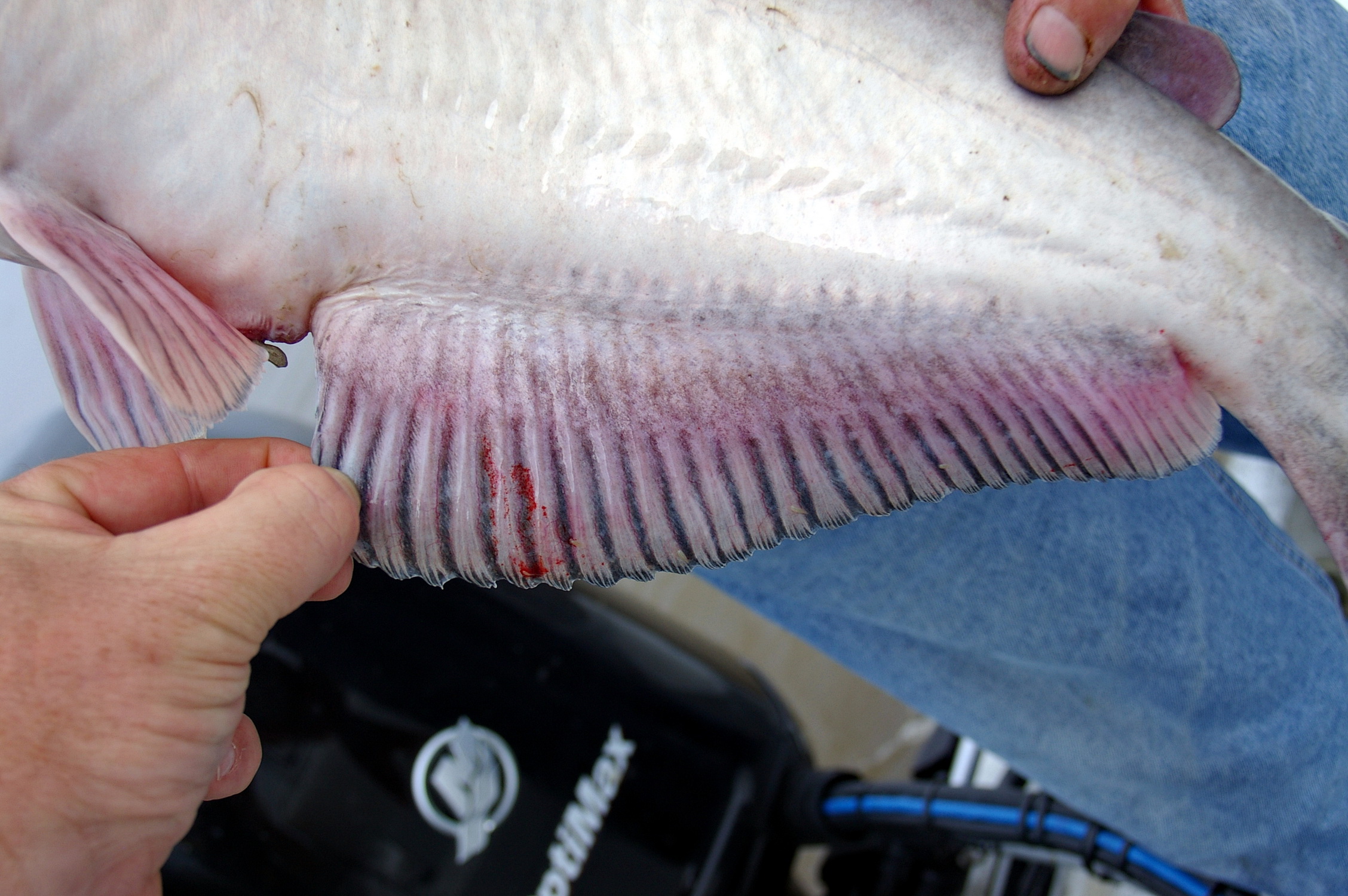
A straight-edged anal fin, shaped much like an old-fashioned
barber’s comb, helps identify this as a blue catfish.
Catfish Basics: Telling Blue Cats from Channel Cats
Story and photos by Keith “Catfish” Sutton

Many anglers have trouble telling blue catfish and channel catfish apart, and it’s easy to see why. These close cousins share a lot of features, including a deeply forked tail and silvery-gray to bluish-black coloration. But with a little know-how, you can tell one from the other every time.
Start with the spots. Channel catfish usually display small black spots scattered along their sides, while blue cats are very rarely spotted. But there’s a catch: older channel cats may lose those markings, so this isn’t a foolproof method.
The best way to tell them apart is by looking at the anal fin (the single fin on the bottom of the fish just in front of the tail) and counting the rays (the stiff, finger-like supports you can see if you spread the fin open).
A channel catfish has a rounded anal fin with 24 to 29 rays. A blue catfish has a straighter, more tapered anal fin with 30 or more rays.
If you count fewer than 24 rays and the tail isn’t as deeply forked, you may be looking at a white catfish, another look-alike species.

Color and shape provide more clues. Channel cats often have a silvery-gray to coppery-brown back, fading to a white belly. Breeding males darken to a deep blue-black and develop thick, fleshy lips and a swollen head. Blue cats, on the other hand, are typically slate-blue to grayish, sometimes appearing nearly white in muddy water—hence their nickname, “white cat.” Many blues also have a distinct hump-backed look and a smaller head in proportion to their body compared to channel cats.
Size is another giveaway. In most waters, channel cats average 1 to 5 pounds, with 10-pounders being good fish and 20-pounders true trophies. The all-time world record—a 58-pounder from South Carolina’s Lake Moultrie—has stood since 1964 and may never be beaten.
Blue cats, by contrast, can reach much greater sizes. Fish up to 10 pounds are abundant in healthy populations, and 20- to 60-pounders are not at all unusual in prime waters. True giants weighing 60 pounds or more are uncommon but certainly possible, and these hard-hitting heavyweights are what draw many catfish anglers to the chase.
So next time you land a silvery catfish and aren’t sure which species it is, take a close look at that anal fin. It’s the surest clue in telling blues from channels—and may even help you realize your “10-pound channel” is actually a small blue in disguise.
