

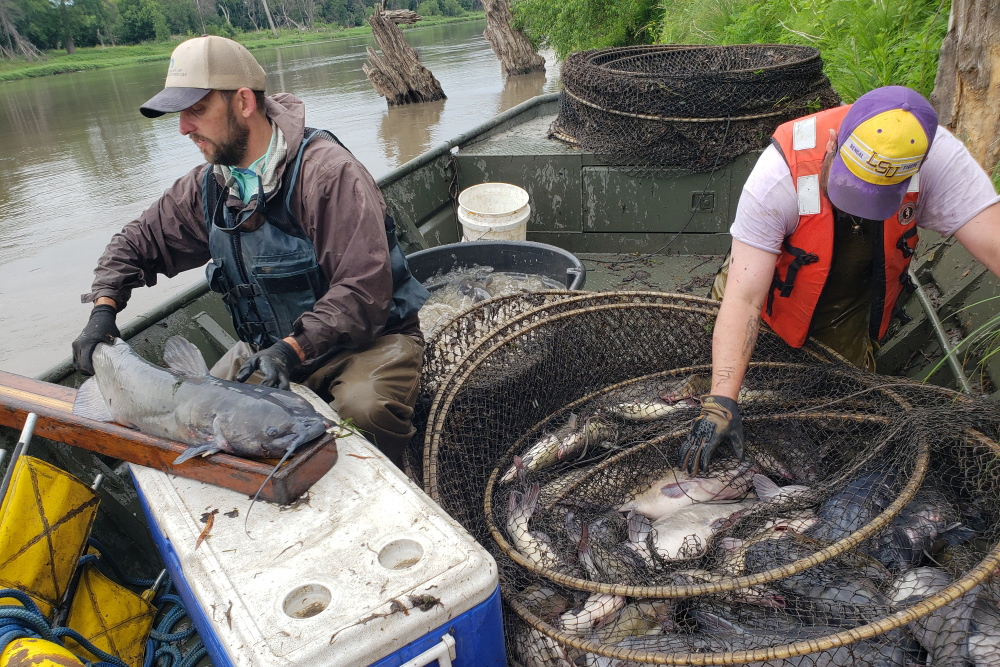
Workers from the Minnesota DNR collect data to assess the Red River’s population
status during test netting in 2025. (Photo by Nicholas Kludt, Minnesota DNR)
Catfish Conservation and Management That Works
by Brad Durick
Minnesota has taken catfish conservation very seriously for more than three decades. Today, the story is one of great success.
The mighty Red River of the North is one of the most fabled channel-catfish fisheries on the planet. Since the 1980s, it has been featured in numerous articles and videos that talk about the giant channel cats that call it home. The question is why and how a fishery like this can sustain such a large amount of trophy fish with the popularity of catfishing and the efficiency with which anglers can catch them nowadays.
In an information sheet from, Nicholas Kludt, the Red River fisheries biologist for the Minnesota Department of Natural Resources (DNR), it was noted in the late 1970s and early 1980s that overharvest of trophy channel cats was starting to be a concern. This concern was due to increasing numbers of American anglers fishing the lower Red in Manitoba, Canada.

These concerns led to strict catfish limits on the Red River. In 1981, the Canadians implemented an eight-fish limit. In 1990, the Red River border states of North Dakota, Minnesota and South Dakota imposed a five-channel-catfish limit, with only one fish over 24 inches allowed per day. The Canadians tightened the regulations to no fish over 24 inches in 1992. These limits remain today on the Red River.
The Red River regulations paved the road to Minnesota implementing a statewide inland catfish limit and season (in waters beyond the Red River and other border waters) of five fish, no more than two of which could be flathead catfish and only one could be over 24 inches in 2003. In 2025, this was updated to five channel cats with only one over 24 inches and two flatheads with only one over 24 inches. There is also a closed season on flathead catfish from December 1 to March 31, to help prevent snagging of vulnerable fish under the ice.
Other regulations are different where Minnesota borders Wisconsin, Iowa and South Dakota. A couple notable regulations are that the same limits pertain to the St. Croix River where it borders Wisconsin, and the Mississippi and Lake Pepin have a limit of 10 with one catfish over 30 inches. Other regulations may differ slightly as you get into other border waters.
In an interview with Minnesota DNR’s Nicholas Kludt, he said these limits were imposed to protect the size structure of the catfish. When asked if it worked, he answered with an emphatic “Yes!” Right after that he was asked if the move to promote catch and release besides these strict regulations has helped the fish. He responded with, “Absolutely, the recycling of large channel catfish works both theoretically and actually.”
It wasn’t until the late 1990s when this author moved to Grand Forks. It was in 2001 when I first got serious about catfishing on the Red River, many years after these measures were taken to protect the size structure of the catfish.
As an active participant and observer over the past 25 years, I, too, can say that these limits and precautions have saved the trophy size structure of the decades past, and many could say we are still experiencing the “good old days” even in 2026.
Is there more than can be done to make catfishing even better on the Red River and across Minnesota? According to Kludt, there is, and much of it is currently a work in progress that starts with the removal of barriers to movement such as low-head dams.
Over the past 15-plus years, a multitude of agencies have been working together to remove the last of the low-head dams or at least replace them with step dams to allow for fish passage. The last of the dams to be changed on the Red River mainstem was completed in 2023.
This barrier removal has already shown to be beneficial in the restoration of the lake sturgeon population, and accumulating data are showing benefits for channel catfish, with signs of improved movement and dispersal. Populations are recolonizing tributary river mileages previously cut-off by barriers. There will be more to come on that in future years.
As a guide who spends many days per week on the river, the signs are pointing to more consistent catfishing in the stretch between the new Drayton Dam and Grand Forks, which could be due to less impediment in movement. It should be noted that river flows during this time have been very stable, which also plays into this.
There are other factors that play into catfish conservation in Minnesota and on the Red River, with the biggest being angler attitude toward catfish. Unlike other places in the United States, catfish are not a sought-after food source but rather a true sport fish, meaning most of the fish are released. Combining that with the strict harvest regulations help to protect them.
It has also been pointed out that in addition to conservation measures, catfishing participation has declined overall since the 1990s. According to the five-year assessments by the Minnesota DNR and North Dakota Game and Fish Department, angler pressure has consistently fallen over the past 30 years. Most of this is in the area of shore fishing.
This is not the case in more populated areas such as the Minneapolis/Saint Paul Metro areas. Catfish participation in those rivers is at an all-time high, and without strict regulations in place would not be as good as it is.
Even with the pressure, we see many trophy flathead catfish being caught and released from the Minnesota and Mississippi rivers, and those areas have become little trophy flathead gems even with the added angling pressure.
Strong catfish conservation and regulation does work to keep a catfish population healthy and maintain a trophy structure for anglers to enjoy. Minnesota is just one state that has been ahead of the curve for protecting the fish to keep the populations healthy for all to enjoy.
Much of what they have done and continue to do can be a blueprint for other states to follow when adopting rules to improve catfish angling opportunities.
(Captain Brad Durick is a nationally recognized catfish guide on the Red River of the North, seminar speaker, and author of the books Cracking the Channel Catfish Code and Advanced Catfishing Made Easy. For more information, go to redrivercatfish.com.)
