

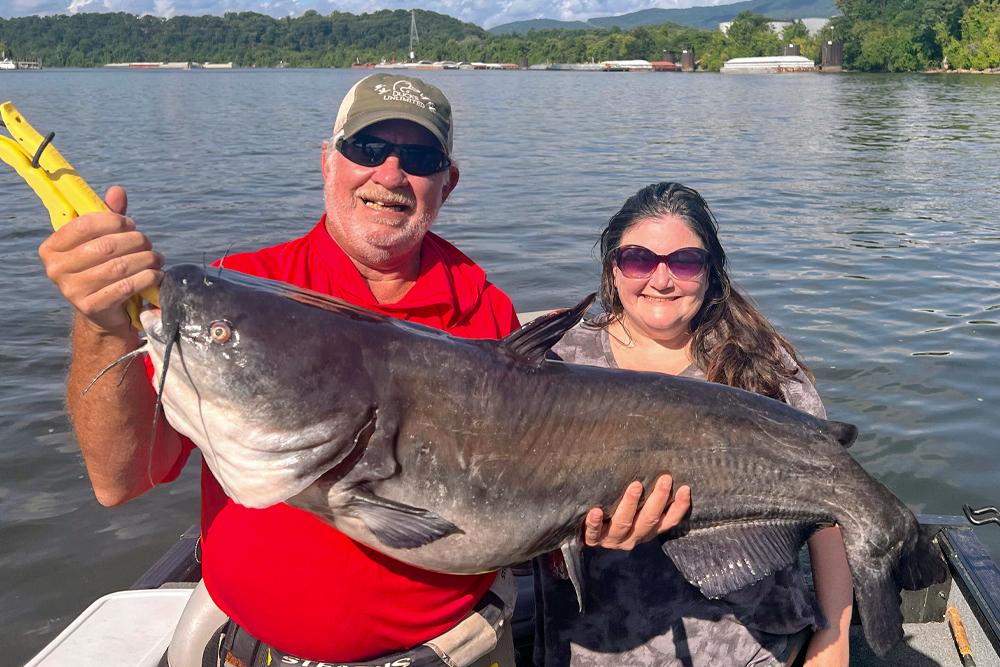
Capt. Richard Simms hefts a big catfish caught by Blair Dunigan on a light-tackle
rig below the Chickamauga Dam. This rig is a versatile tool for Simms.
(Photo by Capt. Richard Simms)
Catfishing Versatility Improves Success
by Terry Madewell
Successful catfishermen understand that every day presents unique challenges, regardless of where they fish. Other anglers, who marvel at their consistency, wonder how these anglers consistently catch catfish year-round.
The short answer is by adapting to conditions, and the core component of adaptation in catfishing is versatility, both in tactics and in achieving the best bait presentation.
Many factors, including seasonal patterns, weather-related impacts and physical factors such as wind, rain, sweltering heat, sleet and snow, influence catfishing success. Add seasonal behavioral changes (such as spawning), forage migrations, current flow or the dreaded lack of current flow as a few additional topics.
Capt. Richard Simms operates Scenic City Fishing Charters in the Chattanooga, Tennessee area. He and his catfish guide partners may fish under vastly different water conditions, often switching from lake to tailwater conditions day to day. Working as a team and sharing information, they have mastered versatility in their catfishing.
On a two-day trip with Simms, we fished the Chickamauga Lake the first day and the fast-flowing tailwaters below Chickamauga Dam (the headwaters of Nickajack Lake) the next.
Simms said the keys to versatility are adapting to the conditions of the day by experiencing them firsthand, understanding what each process requires and then developing the fishing skill sets to adapt to specific targets.
“I see the diversity in fishing areas as a positive because we have access to two different types of catfishing opportunities,” Simms said. “That provides versatility in our fishing waters and requires versatility in tactics to adapt. We keep tabs on both areas in terms of the status of the bite while factoring in the specific goals of our clients, such as seeking trophy catfish or fast action.”
Simms said they can make informed decisions because they’ve developed proven bait-presentation strategies for either situation.
“Learning multiple ways of presenting the bait properly in various situations is crucial,” he said.
When we fished Chickamauga Lake, Simms employed multiple tactics that caught fish, but he continually sought the best method for that day. We fished vertical rigs to target a specific spot on the bottom, then later he anchored and fished flat lines cast to a larger target. Finally, we started “dragging” Santee rigs around the channel ledges and flats.
“All of these tactics are productive, but not necessarily equal on a given day,” he said. “Some anglers prefer to specialize in one tactic, but I think that’s limiting their potential. Becoming proficient in multiple tactics enhances bait presentation. Several factors are at play daily, and a change in current flow through the lake may favor one strategy over another, or windy conditions may dictate the best tactics for that day.
“Producing fish consistently is the key to being a successful guide, and adapting to changing conditions on the lake makes tremendous differences,” he said.
Versatility certainly applies to tailwater fishing, and to many rivers, anywhere current flow dictates strategy.
The next day, we fished the tailwaters of Chickamauga Dam, a completely different catfishing world. We began the day casting into the swift current immediately below the dam, and Simms worked the trolling motor to keep the lines bumping down the river.
“I don’t want the lines very far from the boat. I want them near the bottom but not dredging the bottom,” he said. “The key is to feel for the bite, so we hold the rods, which is different than watching a rod in the rod holder.”
Simms also diversified the bait, using live bait and chunks of chicken breast.
“In moving water, a live shiner minnow or bluegill is a great tool for catching catfish,” he said. “Using live bait in April also allows us to enjoy excellent action from smallmouth bass, while catching catfish at the same time.”
When we drifted a mile below the dam, the current slowed but remained brisk. We continued with the personal touch of holding our rigs to help feel for the bite, and while using Simms’ secret light-tackle catfish rig, my daughter Melissa caught the prized catfish/smallmouth double.
Then Simms shifted strategies again.
“We’ll move a few miles down the river and experience another situation,” Simms said. “We’ll still be drifting, but at a slower pace, and we’ll use the current to drift over a specific target, a deep hole. But unlike when in the lake, we’ll be holding the rod because the bite can be aggressive, but the ‘feel’ is crucial. Holding the rod when the bite occurs is way more fun. If a rod is in a holder, you may miss the hookup, and you will miss the ‘funnest’ part of the experience.”
It seemed Simms had seen this happen before (which, of course, he had) because as the graph depicted the boat coming over the hole, we saw big arches, indicative of catfish, hovering just off the bottom.
“Some good fish are here, and based on where they’re holding, they should be in feeding mode,” he said. “Hold on.”
Just as our baits reached the ledge, we both hooked up, and my rod was almost snatched from my hands. After netting both fish, Simms cranked the motor and headed back upstream, swinging wide of where the fish were holding. Then we drifted the same path again—and caught fish again. And again, until they stopped biting.
“In this scenario, the best bait presentation is by drifting and holding the rod,” Simms said. “It’s weird because it seems logical that they’d be caught by anchoring and vertical fishing, but I’ve tried repeatedly without a bite.”
These strategies are but the tip of the concept of catfishing versatility, but they convey the message well. In the waters you catfish, become versatile in tactics and bait presentations, and you’ll be prepared to cope with the myriad of situations catfishermen encounter. As your versatility increases, so will your consistency in catching catfish.
(Terry Madewell of Ridgeway, South Carolina has been an outdoor communicator for nearly 50 years. He holds a degree in Wildlife and Fisheries Management and has a long career as a professional wildlife biologist/natural resources manager. He’s passionate about sharing outdoor adventures with others.)
