


Guide Mackenzie DelRosso (left) celebrated with stroke victim
Brad Katt after the disabled angler reeled in a healthy blue catfish.
Changing Lives Through Catfishing
By Brent Frazee
Mackenzie DelRosso remembers scanning the crowd during weigh-ins for major catfish tournaments he competed in and always seeing spectators in wheelchairs. That piqued his curiosity. He wondered, “What is their story?” And also, “Wouldn’t it be great to get those people out on the water again?”
For DelRosso, who runs the Katfish Karma Guide Service in northeast Kansas, that was more than just an idle goal.
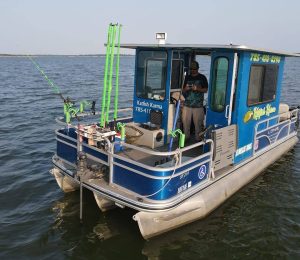
In the midst of a successful guide business for able-bodied anglers, he set his original plan into motion. He had a disabled-accessible boat built to his specifications. The Triton included a wheelchair lift, an enclosed cabin and the heavy-duty framework that could handle the extra weight of a power wheelchair.
Then he advertised on his Facebook page that he was expanding his business to include trips for anglers with disabilities. Within three minutes, he was contacted by a woman who had an unusual request.

“She told me she wanted her family to be my first customers,” said DelRosso, 44, who lives in Randloph, Kansas. “Then, she included this could be a worst-case scenario for a guide trip.”
The woman explained that her son, who was then 24, was left paralyzed from the neck down after a car accident when he was 17. He was confined to a wheelchair and left unable to communicate verbally.
She wondered if DelRosso could take her family out and let the young man just watch his sister reel in big catfish. A short time later, the family joined DelRosso for what became one of his most memorable guide trips.
First, the young man communicated through annunciations to his mom that translated to, “Thank you for getting me out on the water. It means a lot.”
Later, he watched his sister reel in a 42-pound piebald blue catfish, and squealed in excitement as the fish battled and was eventually pulled in.
“It was a pretty emotional moment,” DelRosso said. “It was a moment I’ll never forget.”
So began a specialized service he still offers today. In the last two years, he has guided 18 trips for anglers with disabilities.
His goal? To show that disabilities don’t necessarily end a person’s fishing career.
“Some people that I take out thought their fishing days were over,” DelRosso said. “Maybe they had fished before, but they got seriously injured in a car wreck or a farm accident, and they thought they’d never get out again.
“Then we get on the water and I put them on catfish, and they’re just thrilled. It’s a lot of fun for me, too. It’s my way of giving back to the type of fishing that has meant so much to me.”
DelRosso, who has fished most of his life, developed a fascination for trophy blue catfish when a Kansas Department of Wildlife and Parks stocking program laid the groundwork for a thriving fishery at Milford Lake in the late 1990s and early 2000s.
He also honed his skills at Tuttle Creek Lake near where he lived, another reservoir that built a strong blue cat population following the state agency’s stockings.
DelRosso went on to hit the tournament trail and opened his guide business in 2020. Today, he splits his time between guiding and the tree business he owns. He also fishes tournaments when time allows.
Whether he is guiding or competing in tournaments, his goal remains the same: to catch one of the legendary blue cats Kansas is known for.
“The blue cat is the apex predator in the waters I fish,” he said. “The great thing about fishing some of these reservoirs or the Missouri River, you never know when the next bite you get is going to be the fish of a lifetime.”
Now, DelRosso has taken his love of the sport one step further, helping less fortunate anglers fulfill their dreams. Because many of the disabled fishermen he guides have limited mobility and are unable to cast, DelRosso likes to drift or slowly troll when he has them out.
He is loyal to his Kansas roots and uses mostly equipment from companies based in his home state—7-foot, 6-inch, medium-heavy Slime Cat rods, planer boards made by Kevin Parks Planer Boards and line sold by Neosho River Tackle Company. He uses 80-pound-test braid on his main line and 80-pound-test monofilament for a leader.
He also uses circle hooks because “the fish hook themselves,” he said. That’s important when disabled anglers are unable to perform a hookset.
That formula has led to many memorable fishing trips. He often reminisces about one special moment in 2024. Paul Miller, a former guide and game warden for Kansas Wildlife and Parks, was ailing with terminal cancer and confined to a wheelchair when he heard about DelRosso’s special guide service.
“We started off catching wipers and white bass, but Paul wanted to spend the last part of the trip going for blue cats,” DelRosso said. “Luckily, a rod went down and he ended up reeling in a 42-pound fish.
“That was the last fish he ever caught. He died two weeks later.”
(Brent Frazee is an award-winning outdoor writer and photographer from Parkville, Mo.. He was outdoors editor for The Kansas City Star for 36 years before retiring in 2016. He continues to freelance for magazines, websites and newspapers. When he isn’t writing, he often is fishing on a private lake in the subdivision where he, his wife Jana and their two yellow Labs Millie and Maggie live.)
