

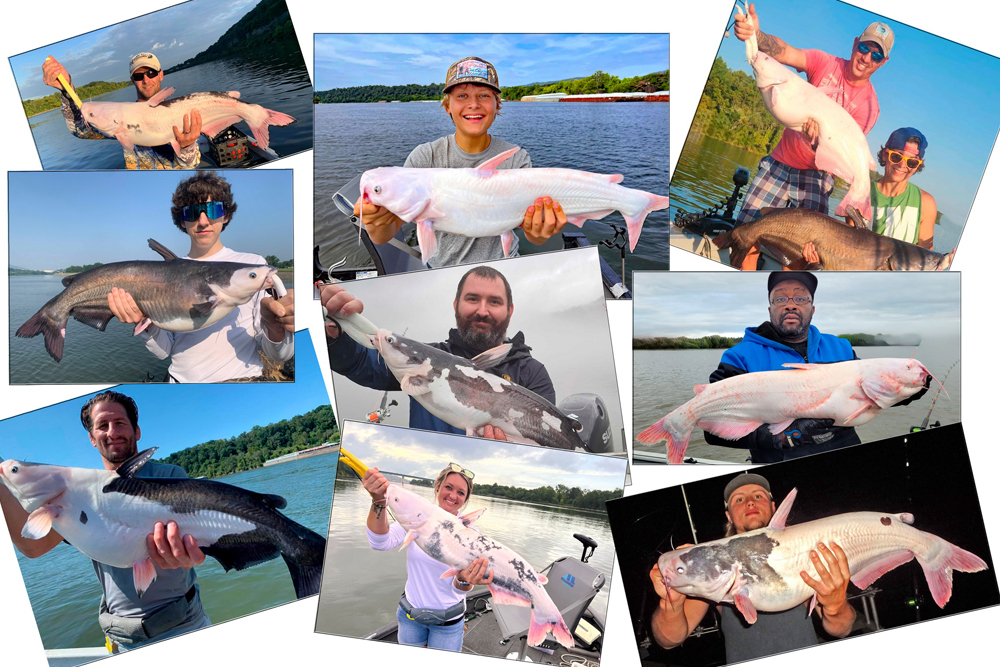
Capt. Richard Simms, his guide partners and friends have been catching a surprising number
of piebald blue catfish from the Tennessee River near Chattanooga, Tennessee. These are just a
few of the piebald fish they’ve seen captured in the last three years. (Photo compilation courtesy Richard Simms)
Crazy Colored Catfish
by Capt. Richard Simms
In most places, they are considered “The Holy Grail” for catfishermen. However rare piebald catfish are showing up in ever-increasing numbers in the Tennessee River near Chattanooga.
Piebald coloration (also referred to as leucistic) is a rare color phase in which an animal or fish’s skin lacks all color pigmentation (appearing as white). The white areas can appear as splotches or, in some cases, cover the entire fish. It is different from an albino, which is always characterized by a complete lack of melanin, resulting in white or pale coloration with pinkish or reddish eyes and fins.
I have been targeting catfish almost exclusively in the Tennessee River in east Tennessee for at least 30 years. My clients and I have boated literally tens of thousands of catfish over the years. For 25 of those years, we never caught, nor had any of our catfishing friends caught, a piebald catfish. The first one I knew of personally was caught by fellow fishing guide Capt. Sam Simons in 2019.
That catch seemed to sort of open the flood gates. Not saying they are common by any means, but more and more, Scenic City Fishing Charters catfish guides have caught increasing numbers or piebald cats, as have many other area catfishermen. In the last three years, Scenic City Fishing Charters clients, along with other hardcore catfishermen I know, have caught at least 15 piebald cats, and perhaps more I haven’t documented.
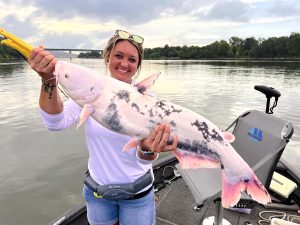
The most recent to grace the bottom of my own boat was caught by regular client Brittany Sapp. Brittany caught this striking piebald (pictured below) June 30, 2025.
Our is not the only area where this occurs. Milford Lake in Kansas has become well known for its numbers of leucistic and piebald catfish. According to this story from KSNT.com, biologists in Kansas conducted electrofishing surveys on the lake and found that more than 13 percent of the blue catfish in the lake were piebald or leucistic.
Based on known local catches, the percentage in Chattanooga-area waters are not anywhere near that high. They are still exceedingly rare. However, the numbers in this portion of the Tennessee River are clearly increasing.
Tennessee Wildlife Resources Agency (TWRA) fisheries biologist Mike Jolley said, “We don’t have any specific data that includes or represents piebald/leucistic catfish within our waterbodies in Tennessee because they are rare.”
Even creel clerks who spend every working day on the water surveying fishermen don’t see them.
So why might this phenomenon be becoming more prevalent among hardcore catfishermen in recent years?
Jolley said, “My research shows that from a genetic standpoint, the piebald gene can be hereditary. This may be magnified more in a population with increased interactions. On the other hand, leucism is basically classified as a defect in the skin, from contributing physical factors, which could be from environmental influences.”
Regardless of the reasons why, catfishermen agree it is special when it happens.
Professional catfishing guide Capt. Aaron Massey said, “When your client is reeling in what you might think is just a 15-pound catfish—routine in our area—then it comes close and you realize it’s a piebald, a routine catch suddenly becomes a lot more exciting.”
The unique fish always create a huge stir on the Internet. Three years ago the story and photo of Edwards Tarumianz (see our front cover photo) went viral and was carried by media outlets around the globe, appearing in Field & Stream, Newsweek, USA Today and multiple other news outlets around the world. Every such catfish I know of was released, as Tarumianz did: (see video to the left)


Upon releasing the rare catch, the 15-year-old Tarumianz displayed great maturity as he exclaimed, “There he goes, back to the depths so another person can catch him.”
In my opinion, the release of those fish back into the gene pool has a great deal to do with the increasing numbers. There is little doubt in my mind that the genes resulting in this anomaly are being passed down from generation to generation.
Capt. Massey said, “The increasing numbers of leucistic blue cats in our area is proof that catch and release works to keep favorable genes in our waters. That can result in more trophy fish that grow bigger faster, as well as these rare piebald blue catfish.”
Besides the rare recessive genetic factor, white catfish obviously face other obstacles. The white coloring obviously makes the fish more visible to predators, especially when they are young.
Don’t ever expect to go out on the river and catch a white catfish. Based on AI inquiry, there are no hard statistics but, “in wild catfish, it is a one-in-tens-of-thousands event, if not rarer.” That’s a hard thing to measure, for sure, but chances are you would still be better off buying a scratch-off lottery ticket.
That said, if you want to up your odds, it appears the Tennessee River in southeast Tennessee would be a good place to do it.
(From Chattanooga, Tennessee, Capt. Richard Simms is owner of Scenic City Fishing Charters, Inc. He began his outdoor career as a Tennessee game warden, later choosing journalism (and guiding) as his chosen profession. Check out his book, “An Outdoor State of Mind.” You can contact him at Richard@ScenicCityFishing.com.)
