

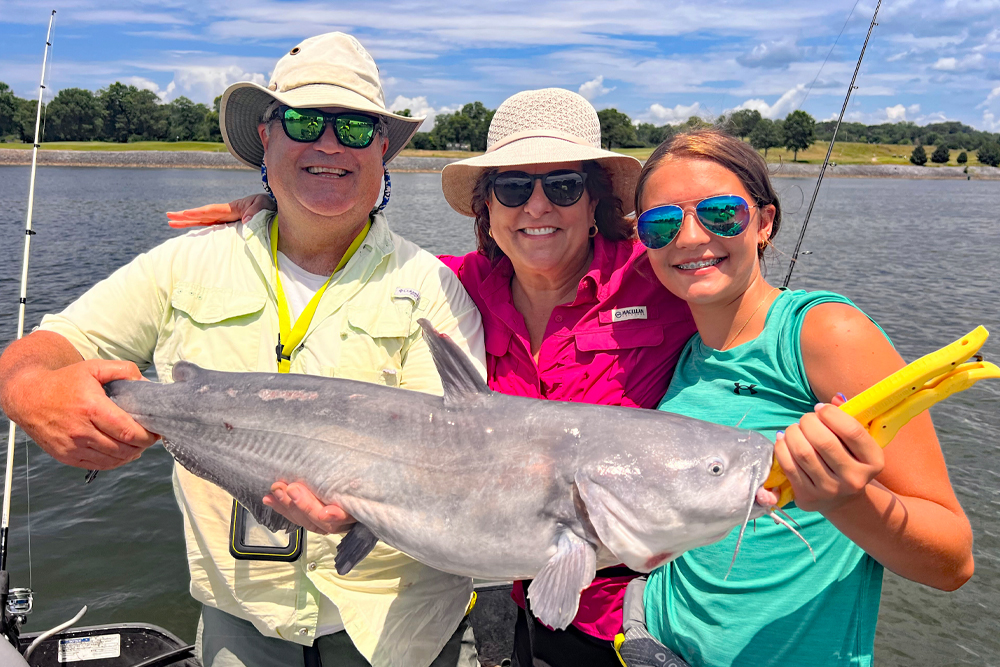
Using the right technique to match the flow conditions at the
time is almost always guaranteed to produce big smiles!
Go With the Flow for More Catfish
Story and photos by Capt. Richard Simms
It was a typical morning catfishing just upstream from Chickamauga Dam on the Tennessee River. With three clients in the boat, we didn’t get on the water until 9 a.m.
“We won’t have too much water flow early, so there is really no point in starting at the crack of dawn,” I told them.
From 9 a.m. to 9:55 a.m., we only put two catfish in the boat. But I knew at 10 a.m., things were supposed to change. Right on schedule, based on the TVA Lake Level App, I heard the warning sirens start screaming at the dam three minutes prior to operators firing up at least two more hydro units. The water flow quickly went from 11,000 cubic feet per second (CFS) to about 35,000 CFS.
These clients wanted catfish to take home and eat, so they brought two extra-large (120-quart) coolers to immediately put their catch on ice.
At 11 a.m., less than one hour after the extra flow began, I crammed a fish into the second cooler and couldn’t close the lid. I told them, “Someone is going to have to sit on that cooler to keep it closed.”
In that one hour of increased flow, we put more than 150 pounds of catfish on ice, also releasing several cats that were way too big to fit in the coolers.
One of my clients, with a huge grin on his face, said, “I see now why you wanted to make it a late start.”
Why Does Flow Matter?
So why does increased water flow help fishing?
Many people believe it does because the increased current stirs up the bottom and starts pushing more potential food downstream. There is probably truth to that, but I have another theory that I believe makes more difference.
When you take your dog outside, he (or she) loves to sniff all the scents they can sniff. But put that dog in your car and drive down the road with the window down. You know what happens—immediately, your dog’s head goes out the window, nose into the wind and their excitement level ramps up tenfold as the good smells increase tenfold.
I think fish react the same way. Whether there is food drifting downstream or not, increased current literally just excites them—and that excites experienced anglers.
Many Cat Anglers Know About Flow
Good flow is no secret to experienced catfishermen who will fish anywhere there is good current. They know good current, versus somewhat stagnant conditions, increases catch rates.
Tennessee River catfish guide Capt. Aaron Massey said, “It can put fish in more predictable areas, and they’re generally more willing to bite.”
Some anglers have to wait on heavy rains to increase flow. But on rivers with hydroelectric dams, such as the 650-mile-long Tennessee River, water flow is almost always dependent upon someone flipping a switch to start more turbines spinning deep inside the dams to generate more electricity.
On the Tennessee River during the summer, there is routinely low flow in the morning. However, as the temperature climbs and more people start turning on air conditioners, the demand for power increases. Hydro power is by far the most cost-efficient way to generate electricity. That’s when those switches get flipped, and it’s like turning on a faucet.
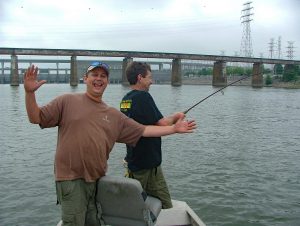
Capt. Massey said, “I’ve had good success during this time of year by starting my trips in the afternoon around 4 or 5 p.m. while the current is rolling and fishing until midnight or so. It’s about the only time of year I run evening trips, and many of my guests seem to enjoy it.”
Adjusting For Low Flow
Low-flow conditions and high-flow conditions dictate different fishing methods.
Below Chickamauga Dam low flow conditions might result in current moving 0.5 mph, or less.
Catfish guide and YouTuber Capt. Joe Jellison said, “If current is low, I typically stay in the tailwaters closer to the dam, or I go downriver and pull out some planer boards and drag upriver. I started utilizing that technique last year and have had great success.”
Capt. Sam Simons said, “If there’s no current, I will drag baits to try to cover ground. Or I like to fish down lines and bump my trolling motor, trying to hold the baits vertically beneath the boat. If there is low current, I try to stay near the dam because the current does slow down the farther you go downstream.”
Adjusting For High Flow
High-flow conditions on our section of the Tennessee River send the water pouring downstream at 2.0 or 3.0 mph, perhaps even more. That is when we will switch to anchor fishing. With this technique, we routinely use trolling motors to spotlock upstream of targets such as fallen trees, underwater ledges, holes or even underneath barges tied up along the river. With low flow, you typically need to cast baits extremely close to those targets.
However, with high-flow conditions, you can often cast well upstream—maybe 10-20 feet or more—of such targets. With better scent conditions and fish hopefully excited by the extra flow, they are more likely to leave their tight cover in search of your bait. Big fish are also less likely to run back into structure and break off.
Sometimes higher flow equals muddier water. Capt. Massey said, “Catfish especially do not mind muddy dirty water. They have more taste sensory receptors than any other freshwater fish. Their skin is literally covered in taste buds, making them like big swimming tongues.”
However, we do often still love to drift fish. Personally I always believe drifting and covering more water results in more bites.
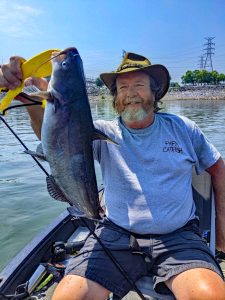
In deeper water, 20 feet or deeper, we will typically set several rods for a suspend drift. We drop baits to the bottom, reel up about four feet to avoid snags and simply float down the river until a rod bows down. It is important to monitor electronics, watching for humps or holes. You often have to reel up or drop down to either avoid snags or keep baits in the best strike zone.
Light-Tackle Technique
My guide partners and I have what we consider a secret weapon. We call it our “light-tackle technique.” It is best in the summer when you want lots of action on eater cats in that five- to 15-pound range. But we’ve also caught a lot of trophy fish using our light-tackle technique as well.
The rig is simple. I typically use 20-pound-test braided main line with a 20-pound mono shock leader connected via a two-way swivel. My preferred hook is a 3/0 Kahle.
The true secret of the technique is weight, or actually the lack of weight. I always tell folks to “use the least amount of weight possible.” That includes sometimes using no weight. I prefer fishing with chunks of plain chicken breast, roughly the size of a ping pong ball or a golf ball. When fished on a slack line, the chicken breast is dense enough to slowly sink of its on accord.
We cast it directly upstream of the boat and drift at the exact same speed as the current. On a free drift on a slack line, the chicken sinks naturally. Depending on the flow, you can cover 1.5 to 2 miles of river in an hour. On the Tennessee River, you are almost certain to find fish covering that much water. More details about the technique are available in this CatfishNOW article by Terry Madewell.
I hear fishermen all the time who avoid tailwaters like the plague. They’re used to fishing slack-water reservoirs and say, “I just can’t fish in all that current.”
They just need to learn how to use current to their advantage and not fight it, remembering that, “The flow is your friend.”
(From Chattanooga, Tenn., Capt. Richard Simms is owner of Scenic City Fishing Charters, Inc. He began his outdoor career as a Tennessee game warden later choosing journalism (and guiding) as his chosen profession. Check out his book, “An Outdoor State of Mind.” You can contact him at Richard@ScenicCityFishing.com.)
