

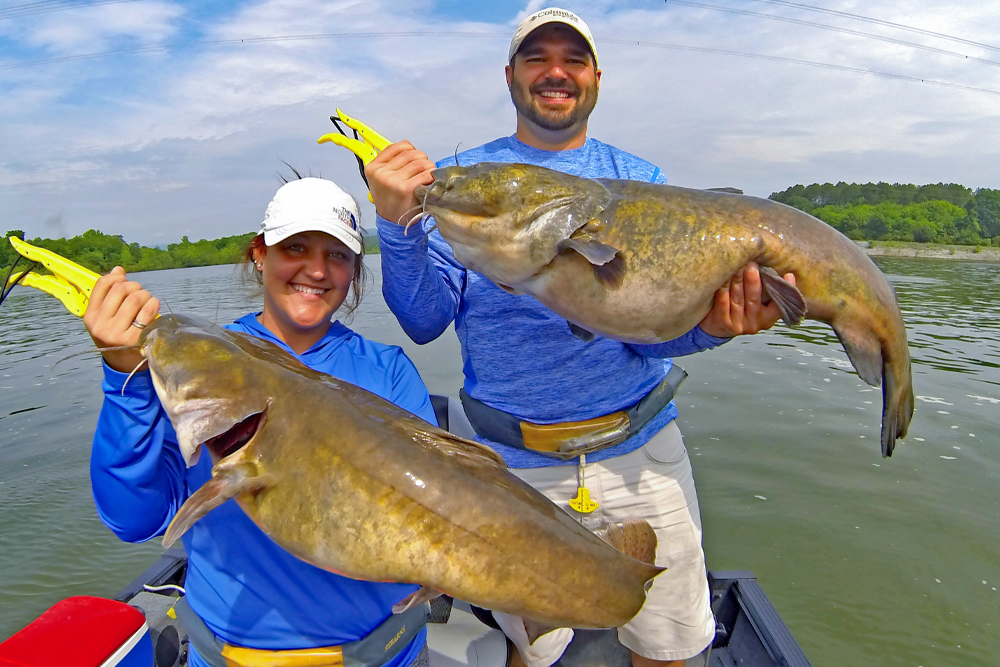
Brittany and Bryan Sapp routinely travel from Pennsylvania to catfish with
Scenic City Fishing Charters. On one of those trips, they targeted flatheads
on the Guntersville headwaters with great success. Photo by Capt. Richard Simms
Guntersville Headwaters = Trophy Flatheads
by Richard Simms
The Tennessee Valley Authority website describes Guntersville Reservoir, on the Tennessee River, as having, “Good fishing, clear waters and the beautiful backdrop of the wooded Appalachian foothills.”
Today we’re going to focus on the “good fishing” part, especially as it relates to flathead catfish. Many hardcore catfishermen consider flatheads the Holy Grail of all the catfish species. They are known for their unique appearance, great fighting abilities and as excellent table fare.
Guntersville Reservoir is mostly in northeast Alabama, extending 76 miles from Guntersville Dam upstream to Nickajack Dam, which is in Tennessee. For our purposes today, we will focus mostly on the approximate seven miles of the reservoir located in Tennessee.
Every catfisherman knows that tailwater areas downstream from major dams, especially on the Tennessee River, are hotspots for good catfishing. And those tailwaters beneath Nickajack Dam are especially noted for good flathead fishing.
Well-known catfish guide Capt. Mike Mitchell said, “It’s one of my favorite stretches to target big flatheads in the spring. There are long straight stretches, but it also has some large holes, man-made structure and lots of wood piles on the channel ledges.”
Capt. Mitchell actually fishes both the Tennessee and Alabama portions of Guntersville.
“Guntersville is a great flathead fishery, even down in the lake,” he said. “They are just a super-hard fish to target. We predominantly pursue them in spring—March through May when they are feeding heavy prior to the spawn and they tend to congregate in the upper section from Nickajack Dam and downstream about 30 miles.”
Professional catfishing guide Capt. Aaron Massey remembers one particularly exceptional day fishing the Guntersville headwaters.
“In 2023 I had a group from Ohio for three days of fishing,” he said. “We caught 10 flatheads over 30 pounds, with many others in the 40s. The two biggest were 61 and 60 pounds.”
Capt. Ty Konkle lives in upper East Tennessee. However, he routinely makes the three-hour drive to Nickajack Dam to specifically target flatheads in the spring.
“It does have a good concentration of flatheads,” he said,” primarily due to the abundance of fallen timber and baitfish concentrations.”
Capt. Konkle said he rarely, if ever, driftfishes for flatheads.
“Anchor-fishing structure is the primary method,” he said. “The water is tough to drag or drift due to the number of snags. Finding structure adjacent to deeper stretches of water is ideal for finding flatheads. We usually anchor in such a way to place baits within five yards of the structure.”
Some of that structure, in the form of fallen trees, is often easily spotted along the shoreline. But some excellent log piles are often offshore along the channel drop-off and are only visible via electronics.
Capt. Massey said, “Typically I like to find submerged structure laid down—timber in or near holes or humps. I typically set up on anchor. I especially like the current coming from Nickajack Dam to run over 30,000 cfs (cubic feet per second, monitored via the TVA website or App). I always check the TVA app for the next day’s generation forecast.”
He adds, however, “In flood conditions (70,000+ cfs) I have done well running and gunning laid-down trees coming off the bank around current seams. I will only sit for 10 to 15 minutes. If you don’t get bit, I go ahead and slide down to the next tree. Typically, in these conditions, debris will collect on your lines quickly. Staying on the move will help keep your lines from getting bogged down too bad and help find active fish.”
Capt. Mitchell said, “When the river is flowing, the ledges and brush are key. But if the current is slow flowing, we tend to fish the middle of the river a lot. We catch a good mix of blues and some nice ones as well. It’s typically like a 60/40 mix with mostly blues, but some years the flathead fishing is phenomenal.”
As far as bait, Capt. Konkle said, “Whatever baitfish is the most abundant at the time I’m fishing is my primary bait. If skipjack are running, that is my preferred bait, or gizzard shad. However, if there are not good numbers of shad, bluegills can be very effective.”
There are rare times when the skipjack are running hard that anglers near the dam can simply cast out and catch a skipjack, then immediately put the entire fish, alive, on a weighted line and cast it below the flood gates, near current seams or along the concrete wing walls and get bit by a big flathead in a hurry.
Of course, all these guides practice catch and release on trophy catfish. But most allow anglers to keep smaller fish (less than 15 pounds) to take home and eat. In Tennessee and Alabama, there is no creel limit on catfish. However, both states have a “trophy size limit.” Each angler can only keep one catfish per day that is more than 34 inches long.
Plus, Alabama specifies that, “It shall be unlawful to transport live catfish 34 inches in length or greater beyond the boundaries of this State.”
That means if you launch in Tennessee, below Nickajack Dam, and cross the state line into Alabama, you are forbidden to bring any catfish larger than 34 inches long back upstream into Tennessee while it is still alive.
Capt. Massey expressed some concern that a few illegal commercial fishermen have been known to ply the waters, catching trophy catfish and taking them north to sell to pay lakes. In 2024, there was a major crackdown and several arrests in such a case, including two men from North Alabama.
However, it hasn’t stopped catfishermen from enjoying the fishery.
Capt. Konkle said, “When I first started catfishing this tailwater, I was basically by myself. Occasionally, I would meet a local. But when social media and YouTube took off, the secret got out that this was a flathead hotspot. There have been times that I’ve seen more than 20 catfishing boats out in the first 10 miles of water below Nickajack Dam.”
However, like most productive water on the Tennessee River, the area seems to continue cranking out quality catches.
(From Chattanooga, Tenn., Capt. Richard Simms is owner of Scenic City Fishing Charters, Inc. He began his outdoor career as a Tennessee game warden later choosing journalism (and guiding) as his chosen profession. Check out his book, “An Outdoor State of Mind.” You can contact him at Richard@ScenicCityFishing.com.)
