

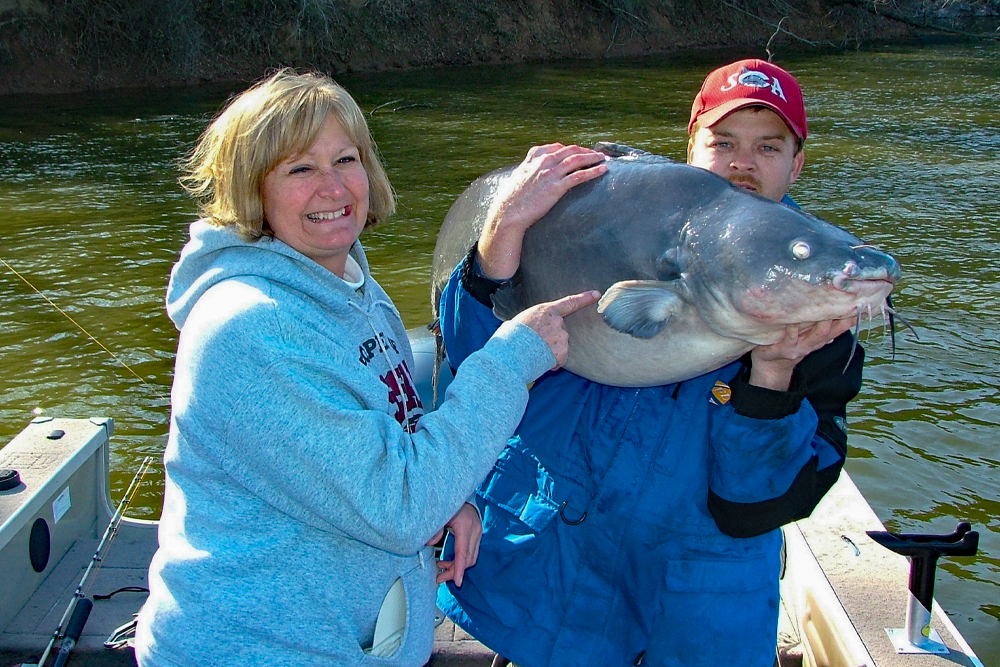
Barbara Simms, the author’s wife, is understandably proud of her personal
best blue catfish (68 lbs.) caught on Wheeler Lake while fishing with
Capt. Mike Mitchell. (Photo by Capt. Richard Simms)
Tennessee River Hotspots: Wheeler and Wilson Built for Trophy Catfish
by Capt. Richard Simms
It had honestly been sort of a slow day. Of course, that isn’t all that unusual when you are specifically targeting trophy blue catfish.
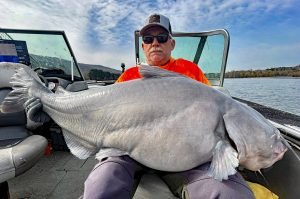
Southern Cats Guide Capt. Mike Mitchell was only using baits that, to me, seemed big enough to choke a horse, much less a catfish. We were using cut skipjack sliced into chunks that weighed at least a half-pound apiece, if not more. So, if a rod tip bowed down, you knew it had to be a larger-than-normal catfish.
We were anchored on the upper end of Wheeler Lake on the Tennessee River, a few miles downstream of Guntersville Dam. A hefty current flowed through fallen trees at the head-end of a rock bluff.
We hadn’t been sitting on the spot long when a rod bowed. My wife, Barbara Simms, was on deck. She moved fast but quickly encountered her first problem—getting the rod out of the rod holder as the huge fish viciously stripped line from the reel, which sounded like a mini buzzsaw.
Barbara finally got the rod from the holder but then encountered her second problem—holding on to the rod as the beast, aided by the stiff current, continued to strip line. She finally got things under control, but the toe-to-toe battle had just begun.
After many minutes, as Capt. Mitchell stood ready with the net, the fish surfaced about 20 feet behind the boat. Barbara, nearly spent, asked Mike with a tone of desperation, “Can’t you reach him yet?”
Looking at the huge fish finning in the current much farther than his net handle would reach, Capt. Mitchell laughed and said, “Nope, Barbara, I’m afraid you’re going to have to get him closer than that.”
Ultimately, the battle was won. Barbara and I watched as Capt. Mitchell struggled mightily, weighing Barbara’s 68-pound personal best.
Experiences such as that are the reason people fish with Southern Cats on Wheeler Lake and the next reservoir downstream, Wilson Lake.
I have been a catfishing guide on the Tennessee River myself for 20 years. Based out of Chattanooga, also on the Tennessee River, we catch plenty of trophy catfish. But consistently I see Capt. Mitchell, and now his son, Capt. Jackson Mitchell, put clients on catfish that are routinely larger than what we see on our stretch of river.
Capt. Jackson, 22, has been working with his father at Southern Cats Guide Service as a U.S. Coast Guard licensed guide for three years.
“I would say Wheeler and Wilson produce more big fish than other pools on the Tennessee River mainly due to how much they are fished,” the younger Jackson said. “They are probably the two most popular (catfishing) bodies of water on the Tennessee River.”
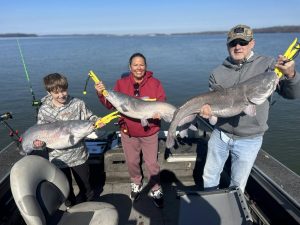
Of course the two lakes are chock full of excellent habitat. It routinely takes between 130 and 140 pounds (three catfish) to win tournaments held on the two lakes.
Capt. Jackson said, “They offer everything from laydown trees, submerged standing trees, rock rows, bluffs, man-made structures such as sunken barges, submerged bridges, locks, roadbeds and house foundations. They also offer shallow and deep water.”
But Wheeler and Wilson do have differing personalities.
“Both lakes are pretty unique,” said Capt. Jackson. “Wheeler offers a long stretch of river that is more narrow and full of structure, where the lower stretch is wider and more lake-like with less structure. Wilson, on the other hand, is the shortest lake on the whole Tennessee chain. That makes it wide and slower, but it is full of structure from one end to the other. Both lakes are just slap full of bait and good genetics.”
Capt. Jackson said his favorite time to pursue trophy catfish is “definitely” December through March. But like all catfish waters, trophy fish can potentially bite year-round.
“My favorite techniques vary depending on the current flow and water temperature,” he said. “During times of slower flow, I prefer to drag baits. But when the current picks up, I prefer to anchor and bump. When water temperatures fall below 45 degrees, I prefer to anchor fish in any conditions.”
Of course, it was natural that Capt. Jackson would follow in his father’s footsteps.
“I like guiding just for the love of the sport, locating fish and sharing that experience with others,” he said.
But he hopes to go “next level” in the coming years.
“I held a Louisiana guide license in 2025, and I plan to return this fall,” he said.
However, he says Wilson and Wheeler will always remain his home base.
Learn more about fishing these lakes with Southern Cats on their web page or Facebook page.
(From Chattanooga, Tenn., Capt. Richard Simms is owner of Scenic City Fishing Charters, Inc. He began his outdoor career as a Tennessee game warden later choosing journalism (and guiding) as his chosen profession. Check out his book, “An Outdoor State of Mind.” You can contact him at Richard@ScenicCityFishing.com.)
