

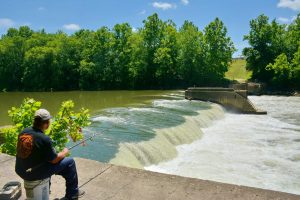
An angler patiently waits for a catfish to bite on the Big Sandy River
near Fort Gay, West Virginia. Sometimes the days can get long, so smart
anglers bring along a folding chair to sit in.
That Darn Dam Fishing
Story and photos by Richard Hines
I recently saw an 1890s photo of people fishing below Rochester Dam on the Green River in Kentucky. Now, 135 years later, anglers including myself are still enjoying fishing from the same rocks where earlier anglers had stood.
Dams like this are great places to catch catfish. Best of all, there are probably some of these thousand plus dams near you. However, no matter if you are in a boat or fishing from the bank or high lock walls, there are some cautionary points to keep in mind.
All Sorts of Fish
Dams have always been one of my favorite places to fish. These are natural gathering locations for a variety of fish species, and regardless of the season or water conditions, savvy anglers are almost guaranteed to catch a fish when visiting them. Commonly caught fish include white bass, yellow bass, catfish and crappie.
I suspect everyone has heard stories about a big catfish seen by divers who refused to return to the area again. I don’t know about that but can say with certainty that every single dam across the country has the same story, and dams are great places to consistently catch catfish.
Fishing below the large dams built by the U.S. Army Corps of Engineers or Tennessee Valley Authority is always a good choice. But these agencies now restrict access to certain locations on dams, both for safety and security. In most cases there are designated public-access points where anglers can easily reach the water. But in locales where big riprap rocks are used to armor the shoreline, anglers should use care to avoid accidents when moving about.
Tackle Tips
Even if I am targeting catfish, I still take a lighter spinning rod with me, specifically to catch panfish or hopefully a skipjack or other fresh catfish bait. If you are catching live fish for cut-bait, be sure to check your state regulations regarding the use of fresh caught baitfish.
When I fish around old abandoned dams, my main catfish rod is a B’n’M Ironside Rod with a Penn Warfare II reel.
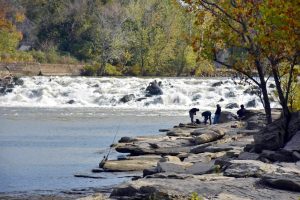
I don’t have any areas where I fish from lock walls, so I use 20-pound test line. If you are fishing from high rocks or lock walls, then you should increase your line and gear to at least 40-pound test.
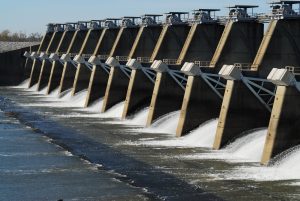
If you are fishing around dams that produce hydroelectricity, get familiar with waterflows during generator operations. Generators affect flows, and the more generators in operation, the swifter and more turbulent the water.
I sometimes fish below Kentucky Lake Dam. In this case, I prefer one or two generators. But if flood gates are open, it’s a different situation with swifter and higher water.
Dams that do not produce electricity but periodically let water out will require you to check flowage. You will hear terms like, outflow, pool levels and cfs (cubic feet per second) mentioned. Most lakes provide online charts that refer to summer pool versus winter pool levels, and understanding these will help you predict when dams may be releasing water.
When fishing around dams, I keep an eye on cfs. As an example, smaller rivers might have regular flows of 200 to 500 cfs, while dams on larger rivers may run around 20,000 cfs. You can become familiar with your local dams by watching the closest U.S. Geological Survey gauge, which can be found on the U.S. Geological Survey’s National Water Information System. This agency has several gauges on every river in the country.
Use Caution
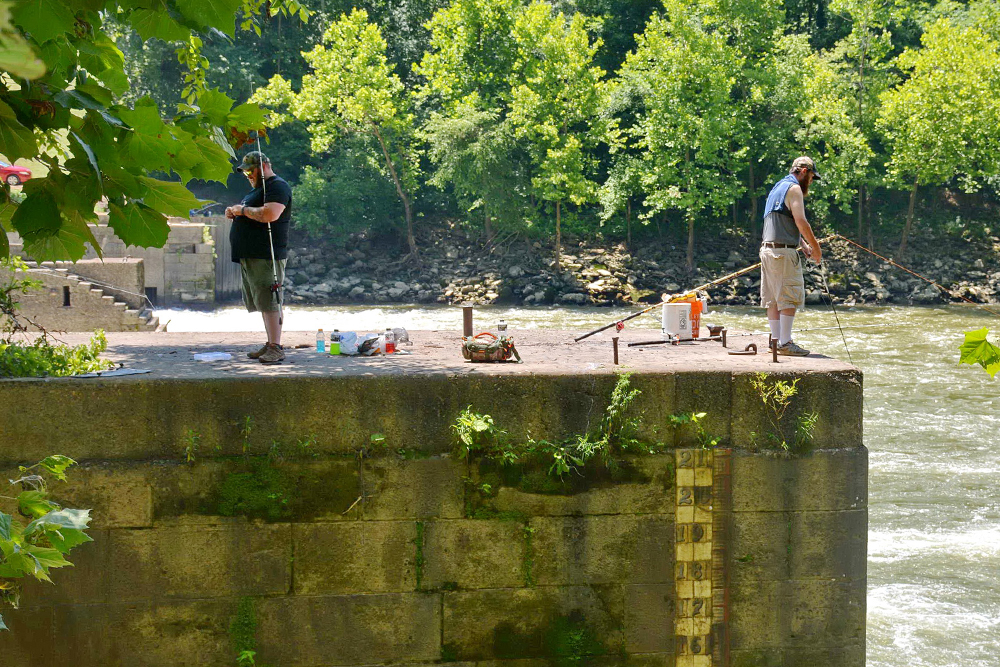
Several years ago, I visited the abandoned Lock and Dam #3 on the Big Sandy River in Fort Gay, West Virginia. Some anglers were fishing along the banks below the dam while others were fishing from the top of the old lock wall.
Locks and dams that are in active use will no longer allow you to fish from these structures. But on many abandoned dams you can fish, and they are the perfect place to intercept a cat. Just remember to upscale your tackle—not just line but rods and reels, too. This is not so much for the fish but to enable you to haul fish up the lock wall. Don’t forget to upscale your hooks as well.
Ron Stallings, who is in charge of marketing for TTI Blakemore Group, the home of Daichi and Boss Kat hooks, said, “In moving water such as being close to a dam, circle hooks have the ability to hook the fish themselves. Especially if you are bottom bouncing. You really can feel the hit to set the hook with a J-style hook. Circle hooks make the connection quickly.”
I always caution people to be careful when fishing from the top of lockwalls as a 10-foot fall into swift water could be devastating. If you don’t know how to swim, fish along the bank below the dam.
Hotspots
While fishing at dams, do not overlook nearby slack water for casting to catch shad or panfish for potential cut-bait. Fish must rest, so when you cast, pick sections of slower-moving water and cast just above these so your lure drifts downstream where fish may be resting. Also remember that as water discharges from turbines, the center of the “swirl” is the fastest, with the outer edges providing slack water.
Also, be considerate of other anglers. Fishing around dams can sometimes get close, so be friendly, keep space between you and other anglers and watch where you cast to prevent lines from getting tangled up.
If you have not fished below any of the dams in your area, give it try and keep the cooler handy for the trip home because you may have fish!
(Richard Hines is a retired wildlife biologist, book author and award winning freelance outdoor writer and photographer. Since 1985, Hines has published hundreds of articles on hunting, fishing, conservation, and natural history.)
