

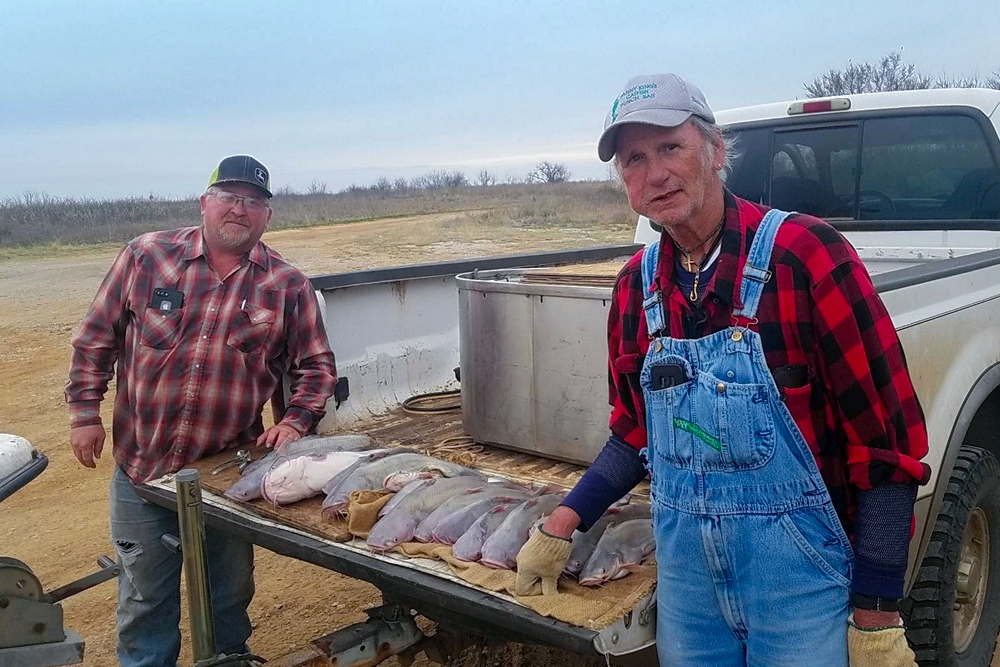
When Danny King (right) uses his stinkbait, there often are catfish headed for the frying pan.
The Bait Stinks, But the Fishing Doesn’t
By Brent Frazee
Photos courtesy of Danny King
What stinks? Well, if you’re fishing with Danny King, you know it has to be the bait he uses.
King, a 76-year-old Texas “good ol’ boy,” has made a career out of stirring up the type of prepared bait that will make your eyes water.
He’ll mix in dead stuff, pond scum, fermented grains, fiber and a few secret ingredients, and there you have it. A gooey paste that smells like roadkill to humans but rings the dinner bell for catfish.
King has been mixing up smelly concoctions for more than 50 years to appeal to the smell and taste buds of big blue and channel catfish. A glance at the mantel piece of his den in Electra, Texas, filled with trophies and awards, indicates that his baits work.
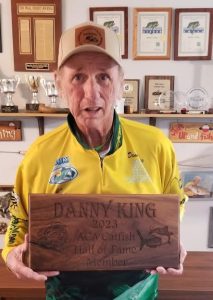
“Catfish bite by smell 90 percent of the time,” King said. “It might smell bad to us, but it smells like dinner to a big ol’ catfish.”
King discovered that by accident when he was in his 20s and fished with a stinky concoction he and his brother made up.
After fishing with minnows, they would toss the dead ones into a bucket and let them ferment in the hot sun for a while, then mash them up and add a few ingredients to make them into a sticky paste. Once that mixture got good and ripe, they had a punch bait that worked immediately.
“I remember the first time I used it, I didn’t have to wait long to get a bite,” King said. “We started adding stuff to it, and we knew we were onto something.”
King created the first version of a punch bait in 1966 and eventually brought his mix to the commercial market in 1991. It proved to be a wild success. Countless anglers sent messages to King about catching big blue cats or channels on his bait.
“Wear disposable gloves or wait until Friday to fish, so you have all weekend for the smell to dissipate … but it is good for catfishing,” one fisherman said in a review.
King eventually sold his company when his wife became seriously ill, but he got back in business when he became involved with a friend’s company, Suki Gizzard Catfish Bait.
“We buy chicken gizzards by the hundreds of pounds and ferment them in that Suki sauce for three months, “ King said. “Then we mix in the other ingredients, and we have something that the catfish can’t resist.”
King has caught blue cats as big as 63 pounds on his foul-smelling baits, and customers have landed cats up to 78 pounds.
In the process, King has disproved some wives’ tales over the years. His biggest catfish have come in water as shallow as 2 to 4 feet. And they’ve been taken from shore, not in a boat.
“A lot of bank fishermen wind up and cast their bait as far out as they can,” King said. “But a lot of times, especially on windy days, the fish aren’t out in that deeper water. They’re right in close to the bank.”
King loves fishing in a howling wind, especially in the spring. He will get off a point where the wind’s blowing in and use his Suki Gizzard bait to target the big ones.
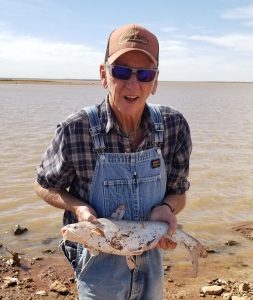
He uses a 7 ½-foot Danny King signature catfish rod, an Abu Garcia Ambassador 6500 reel, a 2-ounce no-roll sinker and a treble hook to hold his bait. The bites can run the gamut from barely distinguishable to jolting.
King will do most of his bankfishing from October to the end of May, when the big cats are shallow. He caught his biggest blue cat in February on Lake Texoma. But he fishes many smaller lakes and holds a number of lake records.
Even in the summer, he will be out searching for big cats. He likes to bait a hole with range cubes to draw the catfish, then come back and fish that area at night.
The scent trail given off by his baits will attract the catfish. But King said it is equally important to know the behavior of the big blues and channels. For example, he will look for little ditches and channels the catfish use to travel from deep water to shallows.
“When the wind’s blowing 25 miles per hour and up, I make sure I’m out there fishing from the bank,” King said. “I’ll set up where the wind’s blowing in my face, and the waves are just crashing in.
“Those are the days when the channel cats are in the shallows, feeding like crazy.”
One more thing: It doesn’t hurt to spit on your bait every so often, King said.
“One time, I was chewing on some tobacco, and I would spit on my bait, and every time I would do it I would catch a fish,” King said. “Well, my dad and a younger boy was with us, and my dad told that boy, ‘Don’t pay attention to my son. That chewing tobacco isn’t good for you.’
“But it was good for me on that day.”
(Brent Frazee has been writing about the outdoors for more than 50 years. He was the outdoors editor for The Kansas City Star for 36 years before retiring in 2016. He continues to freelance for websites, magazines and newspapers. He has won more than 65 national, regional and state awards for his writing and photography.)
