

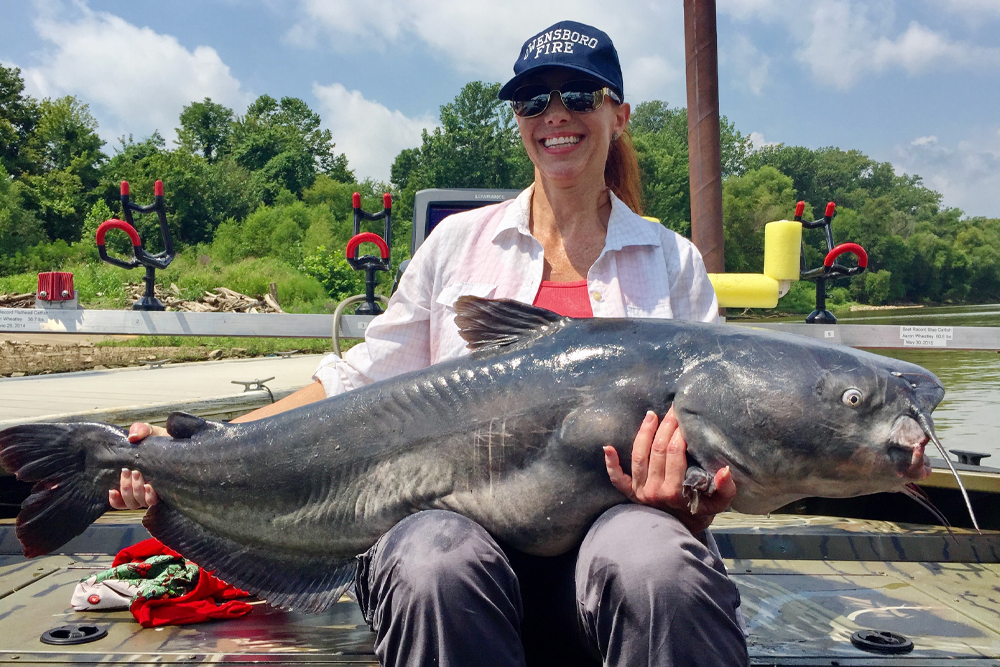
Author Anietra Hamper shows an impressive blue catfish
caught in the Ohio River. Photo by Anietra Hamper
The Status Of The Pay Lakes Controversy
by Anietra Hamper
Where the issue stands after more than 20 years of discussion
Though the controversy over pay lakes is not a new one, the issue continues to evolve as it has done for more than 20 years. Pay lakes are legal businesses that provide unique fishing opportunities for a fee in privately owned ponds around the U.S.

“Many of Ohio’s pay lakes focus on providing a trophy catfishing opportunity for their customers, so they annually stock many large flathead and/or blue catfish into these relatively small ponds,” said Dr. Richard D. Zweifel, Inland Fisheries Program Administrator for the Ohio Division of Wildlife.
For decades pay lakes have remained in the center of controversy, not for how they operate, but for how some of these lakes obtain their stocked fish. Ground zero for this issue surrounds the Ohio River and the states that border this popular waterway for trophy-sized catfish.
Since the large catfishes that pay lakes want to stock cannot be raised economically in aquaculture facilities, they must obtain them from commercial fisheries. Many of these entities operate in the Kentucky, Indiana and Illinois jurisdictions of the Ohio River or in other public waters of the southern and eastern parts of the United States, according to the Ohio Division of Wildlife.
While recreational anglers want the opportunity to catch trophy-sized catfish, and pay lakes are a popular option, many of them are increasingly concerned about the impact on the blue and flathead catfish populations where they are sourced, fueling more debate on the issue.
“Some recreational anglers have expressed concerns over wild catfish being taken from the Ohio River by commercial fishers and then sold to pay lakes,” said Zweifel. “Particularly, that commercial harvest is focused on the large, trophy-sized individuals. Because it takes 10 to 20 years to produce a trophy-sized catfish, they have concerns about those fish being harvested faster than they can be replaced.”
As catfish pay lakes are regulated in some states surrounding the Ohio River and not regulated in others, it is difficult to determine just how many are operating and manage the sourcing of their stocks. In Ohio, where catfish pay lakes are not regulated, Zweifel estimates there are about 50 to 60 operating in the state.
“It’s a bit of a moving target,” said Zweifel. “Some pay lakes are very small operations that come online for only a brief time. Every year there are a number of pay lakes that pop up and then drop out after only one season.”
Confusing the issue even more is that even though Ohio does not regulate pay lakes, it does regulate commercial fishing, the source of some pay-lake stock. Commercial fishing is only allowed in Lake Erie, so Ohio sections of the Ohio River and inland public waters are off limits.
Further adding to the complication is that regulations on both commercial fishing and pay lake vary by state.
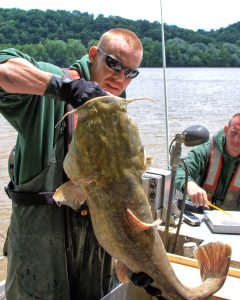
“Anglers often misunderstand this,” said Zweifel. “We cannot regulate what recreational anglers or commercial fishers licensed in other states do within the jurisdictions of those other states. Those state agencies are responsible for regulating the fisheries within their jurisdictions and monitoring for compliance with their rules.”
The state of Kentucky is one of the most aggressive when it comes to regulations for both commercial fishing for trophy catfish in the Ohio River and for the private pay lakes. The Kentucky Department of Fish and Wildlife Resources reports that 68 pay lake are currently operating with valid Pay Lake Licenses that are required to operate in the state.
The Kentucky regulations dictate what sections of the Ohio River within its jurisdiction are open for commercial fishing and have detailed requirements for how the fish are caught. Kentucky regulations also have stringent rules for pay-lake operators to document the payment and transfer of stocked fish, and they impose a limit on how many trophy-sized fish can be stocked in a single calendar year.
An effort to provide cross-jurisdictional communication and monitoring among the states surrounding the Ohio River began in 1990 with the creation of the Ohio River Fisheries Management Team (ORFMT). The ORFMT is comprised of fisheries staff from Ohio, Kentucky, Illinois, Indiana, Pennsylvania and West Virginia. For nearly two decades, the ORFMT has conducted regular catfish population surveys to monitor the potential impact of harvesting.
To date, the team reports that despite the concerns about pay lakes and the sourcing of stocks from the Ohio River, catfish populations remain stable.
“We have not observed shifts in blue or flathead population numbers or size structure since those surveys began,” said Zweifel.
These population surveys will continue through the multi-state collaboration of ORFMT and supplement the monitoring efforts within each state like those in Ohio that are happening despite having unregulated pay lakes.
These efforts include monitoring pay lakes for compliance with operating rules and obtaining fish legally, conducting periodic inspections of licensed aquaculture facilities and bait dealers, and educational efforts providing information to anglers through public outreach.
As this issue resides at the intersection of recreational fishing, conservation and regulation with many stakeholders and states involved, there is no simple resolution for everyone. However, the multi-state collaboration of ORFMT is a step forward, ensuring continued close monitoring of catfish populations in the Ohio River, while enabling legal pay-lake owners to continue to operate and fulfill their missions to offer trophy catfishing to their clients.
(Anietra Hamper is a career television news anchor and investigative journalist turned award-winning outdoor writer specializing in fishing and outdoor adventure. Anietra travels the world fishing for catfish and other unique species in new destinations.)
